You probably already know that as soon as you hear the name GWA Calculator, the Philippines comes to mind. The GWA Calculator is designed to help students calculate their General Weighted Average using their grades and, where applicable, course credit units.
Because grading scales and calculation policies can vary between Philippine schools, colleges, and universities, students should check their institution’s official guidelines before relying on a result for academic decisions. This calculator provides an estimate based on the information entered and the calculation method it supports.
| Course | Grade | Credit Units | Grade × Credit Units |
|---|---|---|---|
| Mathematics | 1.50 | 3 | 4.50 |
| English | 2.00 | 3 | 6.00 |
| Science | 1.75 | 4 | 7.00 |
| Total | 10 | 17.50 | |
Step-by-Step Solution
Step 1: Calculate the weighted grade for each course.
Mathematics: 1.50 × 3 = 4.50
English: 2.00 × 3 = 6.00
Science: 1.75 × 4 = 7.00
Step 2: Add all the weighted grades.
4.50 + 6.00 + 7.00 = 17.50
Step 3: Add all the credit units.
3 + 3 + 4 = 10
Step 4: Divide the total weighted grades by the total credit units.
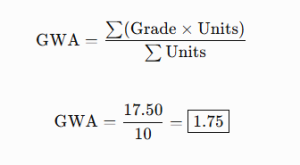
GWA = 17.50 ÷ 10
Final Answer: GWA = 1.75
What is the Meaning of GWA?
The full form of GWA is Grade Weighted Average. A student’s achieved performance is calculated through GWA, which represents the performance during a specific academic term, semester, or the entire duration of the course.
The purpose of all these tools is to combine all subjects and show the average marks obtained.
For example, students can use GWA to summarize their grades across multiple subjects in a semester. The calculation method may vary by school or university, so students should follow their institution’s official grading guidelines.
In the Philippine education system, the GWA is used by many schools and universities to summarize students’ academic performance across subjects. Depending on an institution’s policies, GWA may be considered when evaluating academic standing, eligibility for honors, scholarships, or admission requirements.
Because grading scales and calculation methods can differ between institutions, students should consult their school’s official guidelines to ensure their GWA is calculated correctly. Online GWA calculators can simplify the process by applying a calculation method to the grades and credit units entered by the student.
General Weighted Average, aka GWA Calculator for High School
Globally, the education system has introduced grading systems for students, such as percentage, GWA, and GPA.
You might already know that GWA is especially used in the Philippines, just like GPA is used in the United States, Canada, Australia, the United Kingdom, India, Nepal, Germany, Japan, South Korea, and other countries.
Why Is a GWA Calculator in College Important?
GWA calculator in college is very important because it provides an overview of a student’s overall performance throughout their educational journey. By calculating the GWA, we can get accurate insights into an individual’s scholastic achievements.
The GWA is also very useful to decide if one can get a fully funded scholarship because most academic institutions mention their minimum GWA requirement to get admission there. For example, if a student graduates with a good GWA, they may receive more job offers based on their qualifications.
How to Calculate GWA in the Philippines?
In the Philippines, college students calculate the GWA by adding the weighted grades of all subjects and dividing them by the total number of units (credit hours).
You can see in the image how GWA is calculated: the formula shows that GWA = Total Weighted Grades divided by Total Units, and the result of this division is the GWA.
Now, you might be thinking about how the weight of every subject is calculated. Let’s understand the whole process with the help of two examples – a basic example and a challenging example.
Suppose you are a first-semester student taking three courses: English, Mathematics, and Psychology. Let’s see how to compute GWA now!
NOTE: The following example uses the 100-point grading system used in the Philippines.
Step 1: Input all scores and units.
| Course | Scores | Units |
|---|---|---|
| English | 90 | 3 |
| Mathematics | 92 | 4 |
| Psychology | 80 | 3 |
Step 2: According to the college grading system in the Philippines, assign alphabetical grades and corresponding numerical values to each course.
| Course | Scores | Alphabetical Grade | Numerical Value | Units |
|---|---|---|---|---|
| English | 90 | B+ | 1.75 | 3 |
| Mathematics | 92 | B+ | 1.75 | 4 |
| Psychology | 80 | C | 2.75 | 3 |
Assign Alphabetical Grades and Numerical Values
Step 3: Compute the weighted value for each course and write it into the table. The weighted value for each course is computed by multiplying the numerical value by the number of units.
| Course | Scores | Numerical Value | Units | Weighted Value |
|---|---|---|---|---|
| English | 90 | 1.75 | 3 | 1.75 x 3 = 5.25 |
| Mathematics | 92 | 1.75 | 4 | 1.75 x 4 = 7 |
| Psychology | 80 | 2.75 | 3 | 2.75 x 3 = 8.25 |
Compute the weighted value
Step 4: Calculate the total of Units and Weighted Values.
| Course | Grades | Numerical Value | Units | Weighted Value |
|---|---|---|---|---|
| English | 90 | 1.75 | 3 | 5.25 |
| Mathematics | 92 | 1.75 | 4 | 7 |
| Psychology | 80 | 2.75 | 3 | 8.25 |
| Total | 10 | 20.5 |
Calculate the total of Units and Weighted Values
Step 5: Calculate GWA
GWA =Total of All Weighted Values sum of units = 20.5 10 =2.05
Let’s take another example, where each of your courses has a specific weightage for quizzes, assignments, a midterm, and a final exam. How to calculate the General Weighted Average for each course now? Let’s find out below:
Step 1: Input all scores and the number of units (credit hours).
| Course | Quizzes | Assignments | Midterm | Final Exam | Units |
|---|---|---|---|---|---|
| English | 90 | 85 | 88 | 78 | 3 |
| Mathematics | 92 | 88 | 90 | 95 | 4 |
| Psychology | 80 | 75 | 85 | 82 | 3 |
Scores and number of units
Step 2: For each course, assign weights to quizzes (30%), assignments (20%), midterm (25%), and final exam (25%). Then, calculate weighted values for quizzes, assignments, the midterm, and the final exam. Once calculated, insert them into the table.
English
Quizzes: 90 x 0.30 = 27
Assignments: 85 x 0.20 = 17
Midterm: 88 x 0.25 = 22
Final Exam: 78 x 0.25 = 19.5
Mathematics
Quizzes: 92 x 0.30 = 27.6
Assignments: 88 x 0.20 = 17.6
Midterm: 90 x 0.25 = 22.5
Final Exam: 95 x 0.25 = 23.75
Psychology
Quizzes: 80 x 0.30 = 24
Assignments: 75 x 0.20 = 15
Midterm: 85 x 0.25 = 21.25
Final Exam: 82 x 0.25 = 20.5
| Course | Quizzes (30%) | Assignments (20%) | Midterm (25%) | Final Exam (25%) | Units |
|---|---|---|---|---|---|
| English | 27 | 17 | 22 | 19.5 | 3 |
| Mathematics | 27.6 | 17.6 | 22.5 | 23.75 | 4 |
| Psychology | 24 | 15 | 21.25 | 20.5 | 3 |
Step 3: Calculate the GWA for each course and insert it into the table. It is calculated by adding all weighted values (weighted quiz, assignment, midterm, and final values) for each course and dividing by the total weight or percentage of all categories (quiz, assignment, midterm, final exam, etc.).
- English: 27 + 17 + 22 + 19.530+20+25+25= 85.5100= 0.855
- Mathematics: 27.6 + 17.6 + 22.5 + 23.75 30+20+25+25= 91.45100= 0.9145
- Psychology: 24 + 15 + 21.25 + 20.5 30+20+25+25= 80.75100= 0.8075
| Course | Quizzes (30%) | Assignments (20%) | Midterm (25%) | Final Exam (25%) | Weighted Value | Units |
|---|---|---|---|---|---|---|
| English | 27 | 17 | 22 | 19.5 | 0.855 | 3 |
| Mathematics | 27.6 | 17.6 | 22.5 | 23.75 | 0.9145 | 4 |
| Psychology | 24 | 15 | 21.25 | 20.5 | 0.8075 | 3 |
Step 4: Calculate the Overall GWA for all courses.
| Course | Weighted Value | Units | Total Weighted Value(weighted value * units) |
|---|---|---|---|
| English | 0.855 | 3 | 0.855 x 3 = 2.565 |
| Mathematics | 0.9145 | 4 | 0.9145 x 4 = 3.658 |
| Psychology | 0.8075 | 3 | 0.8075 x 3 = 2.4225 |
| Total | 10 | 8.6455 |
Calculate the Overall GWA for all courses
GWA = Total of All Total Weighted Values sum of units = 8.6455 10 =0.86455≈ 0.865
Looking for a mathematical formula to handle any scenario? Here it is:
GWA = i=1n(WeightedGradei * Units)i=1nUnitsi
In the above formula:
- n – denotes the number of courses
- WeightedGradei – It is the weighted grade (weighted value) for the ith course.
- Unitsi – It represents the number of units or credit hours for the ith course.
- i – It starts from 0 and goes up to n.
Even if you follow the method shown in the two examples, you can still calculate the result manually. However, calculating GWA manually can take a lot of time and may lead to mistakes. That’s why, with the advancement of technology, we now bring you a GWA Calculator.
You can use this calculator on any device, anytime and anywhere—all you need is a device and an internet connection.
How to Use the GWA Calculator Online?
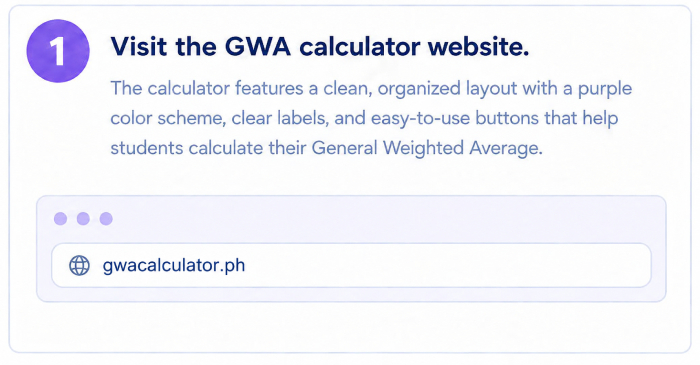
Step 1: Visit the GWA calculator website. The calculator features a clean, organized layout with a purple color scheme, clear labels, and easy-to-use buttons that help students calculate their General Weighted Average.
Step 2: Input the course details, as shown below. Enter the subject name in the Subject field, your grade in the Grade field, and the corresponding credit units in the Units field.
For example, enter Maths as the subject, 1.75 as the grade, and 3 as the units, as shown in the screenshot.
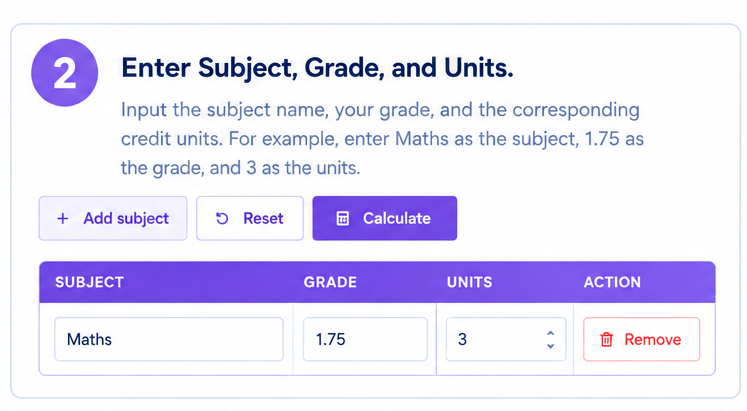
You can add more courses by clicking on the Add subject button. The calculator arranges each subject in a separate row, making it easy to enter multiple courses on the same screen.
Step 3: Click the Calculate button to get the GWA instantly. Using the example above, if Maths is your only subject and has a grade of 1.75 with 3 units, the calculator displays a GWA of 1.75, a total of 3 units, and 1 subject.
The result appears in a prominent section below the subject fields, so you can quickly review your academic average.
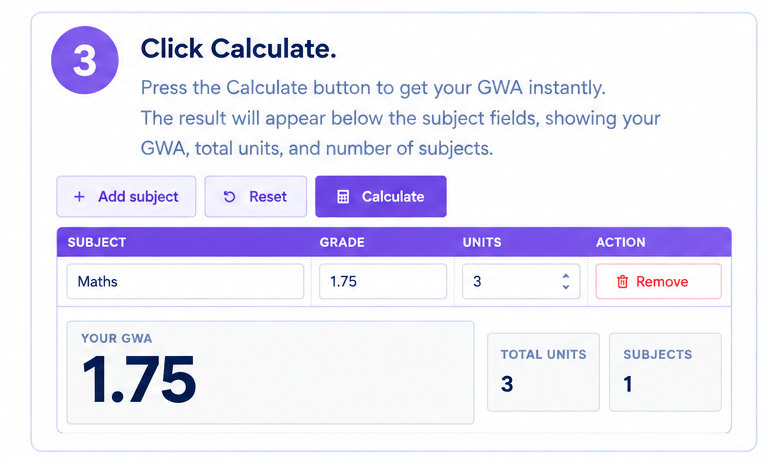
You can do other operations, such as clicking Remove to delete a course, Reset to clear the entries and start over, or Add subject to include more courses.
The buttons use different visual treatments to make the main calculation action and other controls easy to identify.
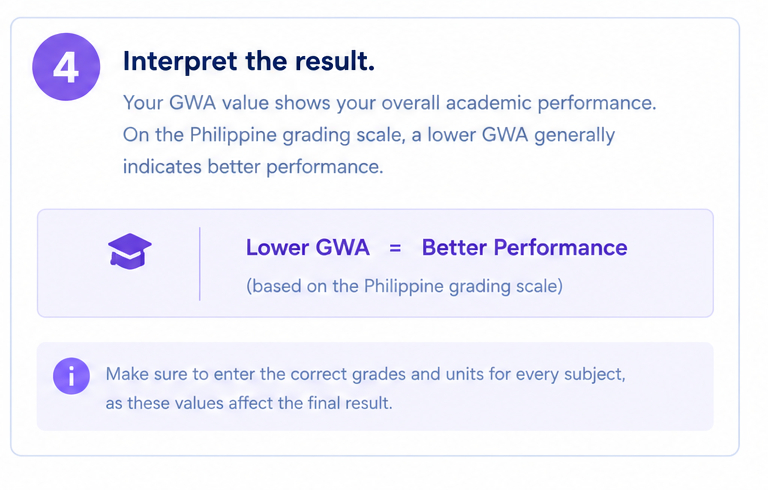
Step 4: Interpret the GWA Result. As soon as you hit the Calculate button, you will see your GWA on the screen. This value denotes your General Weighted Average and shows your overall academic performance.
Remember, the lower the GWA, the better the performance when following the grading scale used by your school. Make sure to enter the correct grades and units for every subject, as these values affect the final result.
Different Methods of GWA Computation
The General Weighted Average (GWA) is used by schools and universities to show a student’s overall gwa. There are different ways used for GWA computation, and each school might use a different method. Here’s a breakdown in simple terms:
- Basic Average Method
This is the simplest way to calculate GWA. You just add up all your grades and divide by the number of subjects.
Example: If your grades are 85, 90, and 88, you do (85 + 90 + 88) ÷ 3 = 87.67. - Weighted Average Method
Some subjects might be more important, so they get a higher “weight.” You multiply each grade by the weight of that subject, then divide by the total weight.
Example: If one subject is worth 3 units and another is 2 units, you multiply the grade by those units before adding them together. - Percentage-Based Method
In some schools, grades are given as percentages. Here, your GWA is the average of all those percentages.
This is mainly used in schools that use percentage marks instead of letter grades. - Cumulative GWA Method
This is used when you want to calculate your GWA for multiple semesters. You add up all your GWAs from each semester and divide by the number of semesters.
Example: If your first semester GWA is 88 and your second semester GWA is 90, then you do (88 + 90) ÷ 2 = 89.
Each method helps show your academic performance, but it depends on what your school uses.
Tips for Improving GWA
Effective Study Habits:
Establishing effective study habits, such as creating a study schedule, staying organized, and minimizing distractions, can significantly improve GWA. Consistent and focused study sessions contribute to better retention and understanding of the material.
Time Management Techniques:
Proper time management is crucial for maintaining a balanced academic life. Prioritizing tasks, setting realistic goals, and avoiding procrastination can lead to better time utilization and higher academic performance.
Seeking Help and Support:
Students should not hesitate to seek help or guidance when facing academic challenges. Whether from teachers, tutors, or classmates, seeking support can enhance understanding and ultimately impact GWA positively.
Benefits of Calculating GWA Online
Why should you prefer calculating GWA online rather than manually? There are multiple benefits of using it, some of which are given below:
Accuracy
Assume you are calculating the GWA to decide where to apply for a scholarship. A small mistake in the calculation can prevent you from getting admission to your favorite college.
User-friendly Interface and Accessibility
Anyone who has a smartphone or PC with an internet connection can use it from the comfort of their home. You do not need any guidance about how to use it because its graphical user interface is user-friendly and easy to understand for all.
It does not matter whether you are tech-savvy or not; if you have the necessary course information, you can use it easily without any stress.
Additional Features
Online applications for calculating GWA often offer additional features to enhance the user experience. These may include saving and storing previous GWA calculations, allowing for multiple semesters or academic years, and providing graphical representations of GWA trends. A GWA generator is a useful tool in these applications for efficiently calculating and tracking your Grade Weighted Average.
Saves Time
Manual calculations are prone to errors and take a lot of time because doing anything wrong can lead to starting calculations from the first step again. This is where the online GWA computation tool becomes your savior and frees up a lot of time.
Addressing Common Misconceptions about GWA
GWA as the Sole Indicator of Success:
While GWA is an essential academic metric, it should not be viewed as the sole determinant of a student’s capabilities or future success. Each individual possesses unique talents, strengths, and passions that may not be fully captured by a numerical grade.
Overcoming Failure and Bouncing Back:
It is essential for students to understand that setbacks and failures are a natural part of the learning process. Emphasizing growth and resilience over perfection can help students overcome disappointments and perform better in the long run.
GPA vs. GWA: Are They the Same?
No, GPA vs. GWA are not exactly the same, but they are related. I will give you an example—please see below.
GPA is used in countries such as the United States and Canada, which is usually based on a 4.0 scale:
4.0 = Excellent
3.0 = Good
2.0 = Satisfactory
1.0 = Passing
GWA is commonly used in the Philippines, which is typically based on a 1.0 to 5.0 scale:
1.0 = Excellent
2.0 = Very Good
3.0 = Passing
5.0 = Failed
Frequently Asked Questions (FAQs)
What is the equivalent GPA of a 1.00 GWA?
The equivalent GPA of a 1.00 GWA varies depending on the GPA scale used by the institution. However, a 1.00 GWA is generally considered an outstanding academic achievement.
What is the passing GWA in the Philippines?
Passing GWA may vary depending on the specific academic institution or program. However, in general, a GWA of 3.0 or higher than that is considered a passing mark.
Do all schools use the same methodology to calculate GWA?
Well, while there is a general framework for calculating GWA in the Philippines, the specific grading system and scale may be different according to schools and universities.
How does GWA affect scholarships and academic standing?
GWA often plays a significant role in determining eligibility for scholarships, awards, and academic standing. Many institutions set specific GWA requirements for these opportunities.
Can GWA be improved or changed after graduation?
No, once a student graduates, their GWA is typically considered final and cannot be changed or improved. However, GWA calculations during the academic journey can be improved by performing well in subsequent semesters.