
At first, let’s begin with the full form of GPA. The full form of GPA is Grade Point Average. It is a number that represents your academic performance in student life. If a student gets a good GPA, then it becomes easier for that student to receive scholarships, admission to master’s / higher studies, job applications, internships, academic standing, and eligibility for honors/dean’s list, etc. So, students need to score a good GPA properly.
Earlier, the calculation used to be done in percentages. On the gwacalculator.ph site, we have also added a GPA calculator, which students can use as much as they want.
Most colleges use a 4.0 scale; let’s see the grading.
- A = 4.0
- A− = 3.7
- B+ = 3.3
- B = 3.0
- B− = 2.7
- C+ = 2.3
- C = 2.0
- D = 1.0
- F = 0.0
GPA varies depending on the college, university, country, and educational institution; the above is just an example.
When was the first GPA started?
Our question is, if we want to trace the origins of GPA usage, we have to go back to the 1900s. It started 126 years ago from today. In this way, the beginning of GPA can be found globally as well. We can understand this through a timeline, too.
- 1785 – Yale University (USA)
- 1837 – 4-point scale
- 1897 – Letter grades
- Early 1900s – GPA as we know it
The Grade Point Average (GPA) system is different from college to college and university, but it is widely used in colleges and universities, especially on the 4.0 scale.
GPA Using Country
Below, we have presented examples of Asian countries. In GPA as well, we make it clear which scale is used by the following countries. Initially used in the American continent, GPA is now becoming widespread even in Asia.
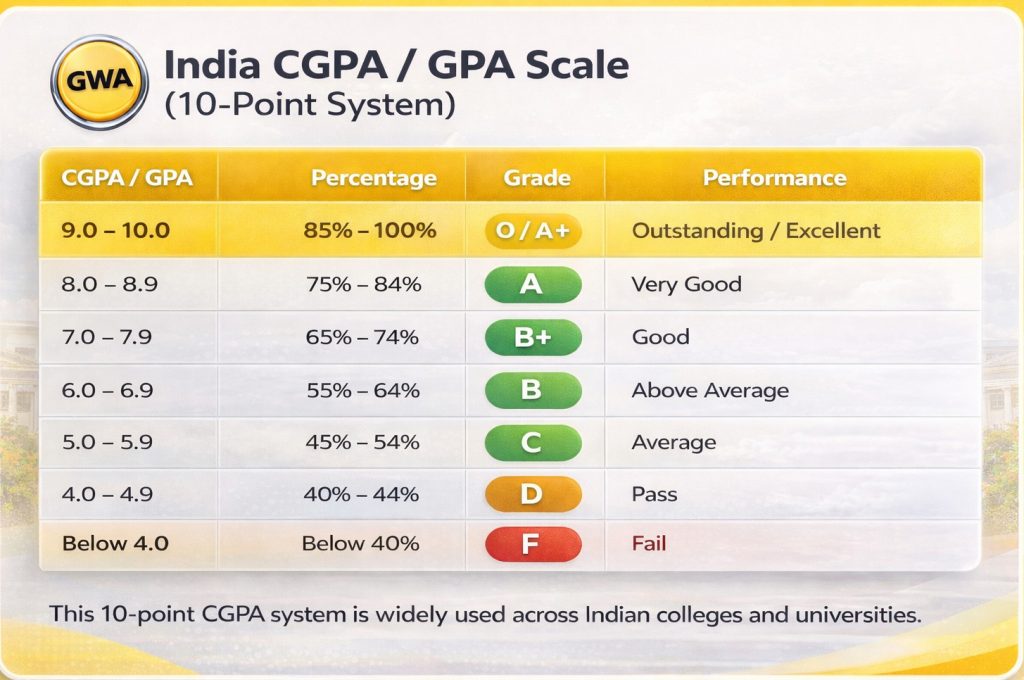
- India → 10-point CGPA
- Nepal → commonly 4.0 GPA scale
- Singapore → mostly 4.0 scale
- Malaysia → mostly 4.0 scale
- Indonesia → mostly 4.0 scale
- China → percentage system + GPA conversion
- South Korea→ often a 4.0 or 4.5 scale in universities
- Japan → often 4.0 or 4.5 scale in universities