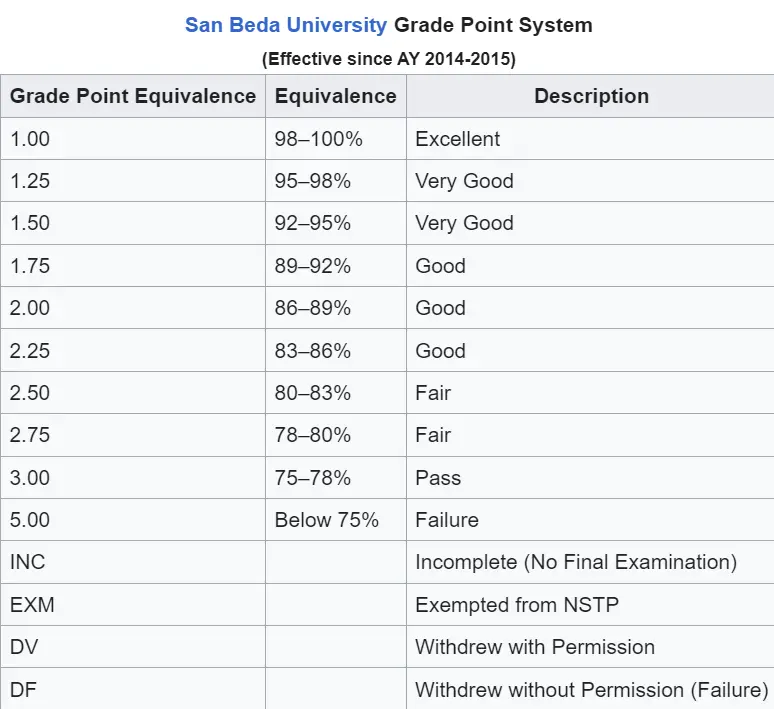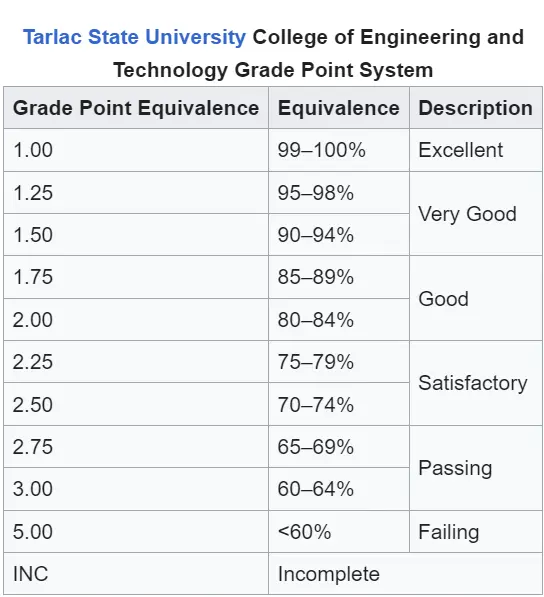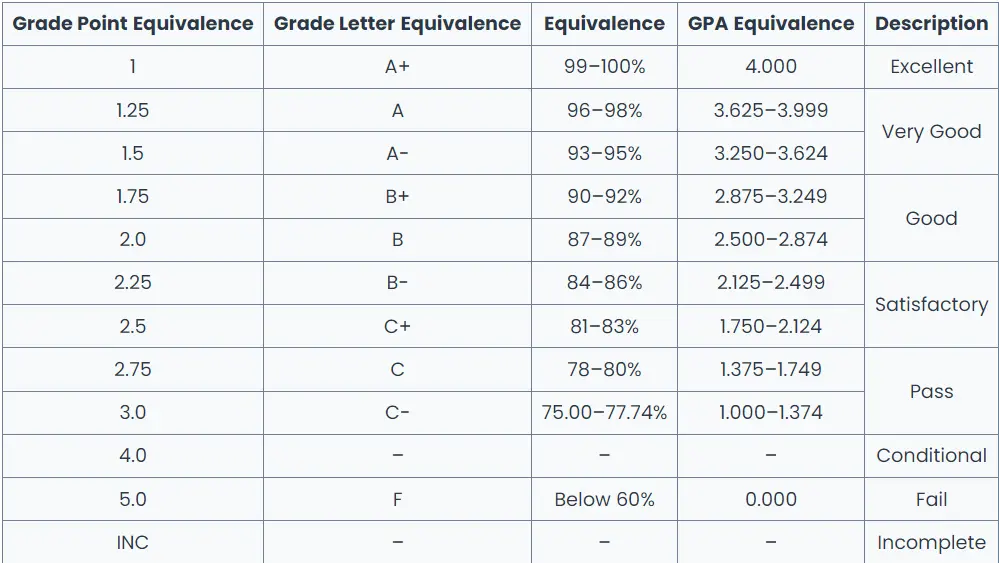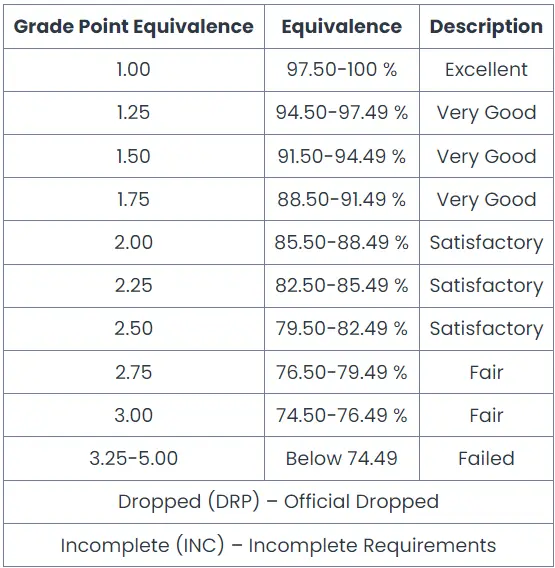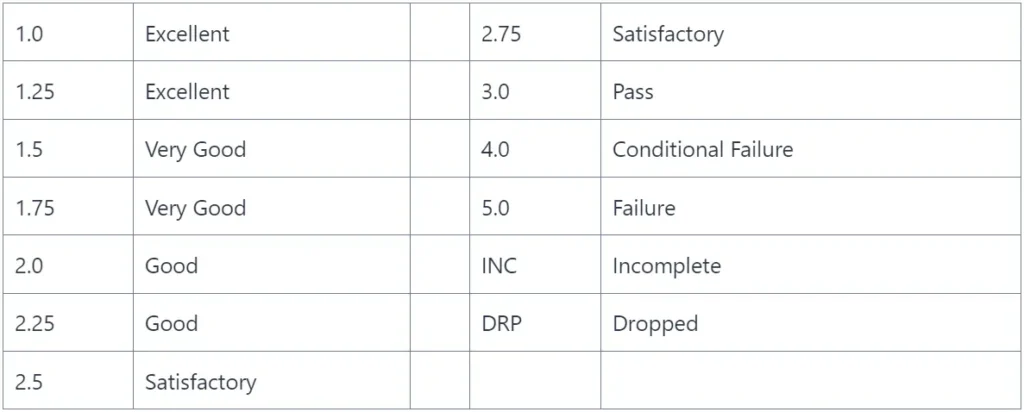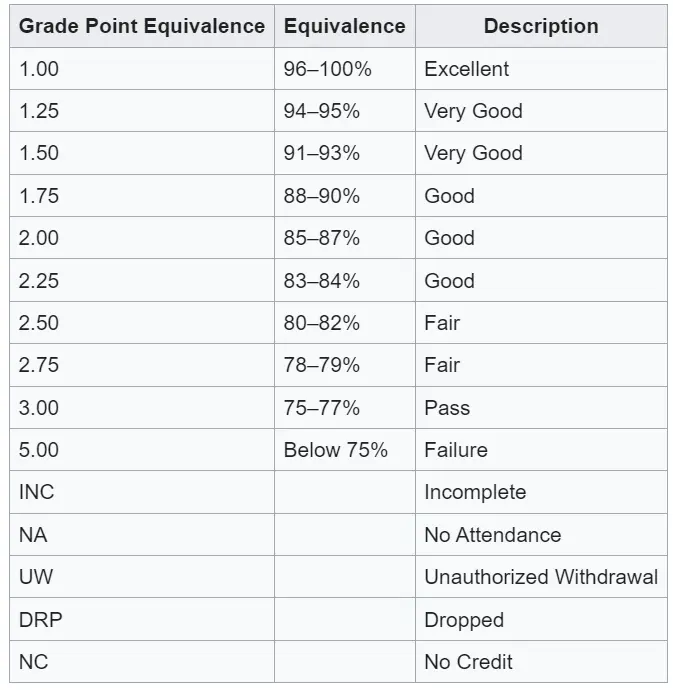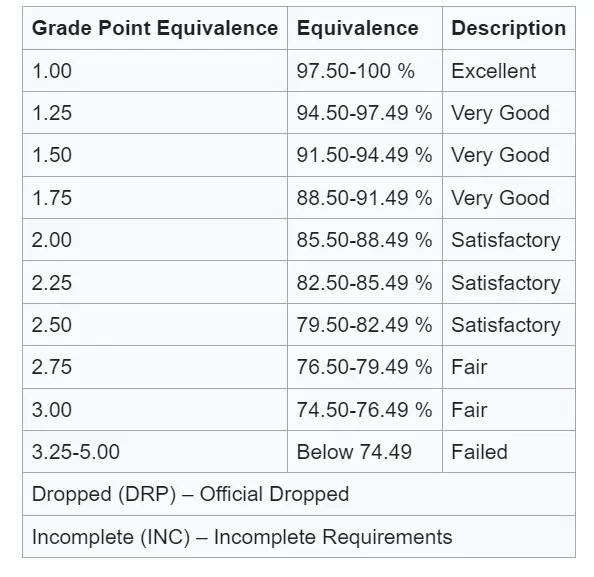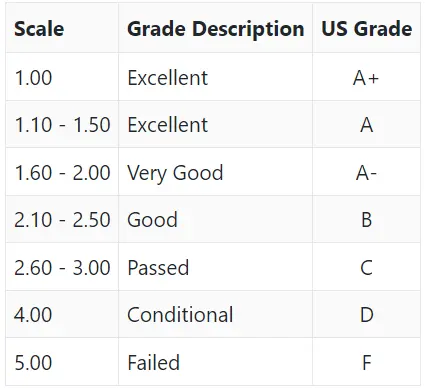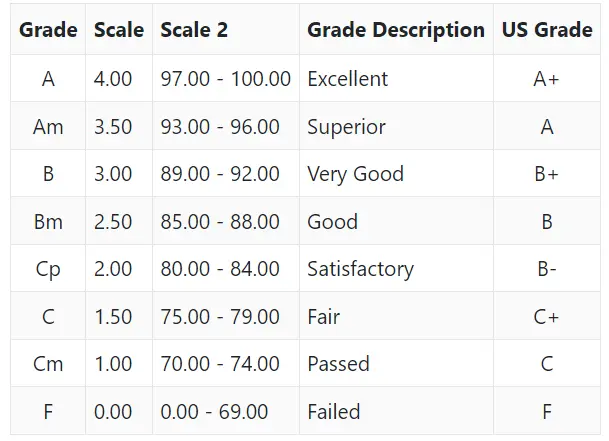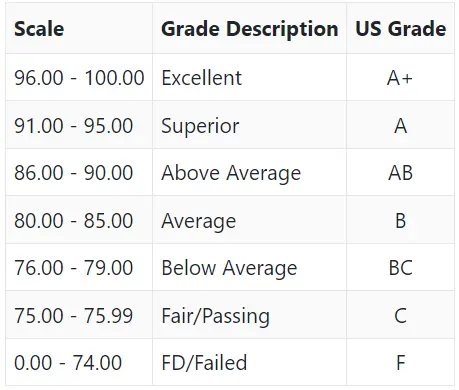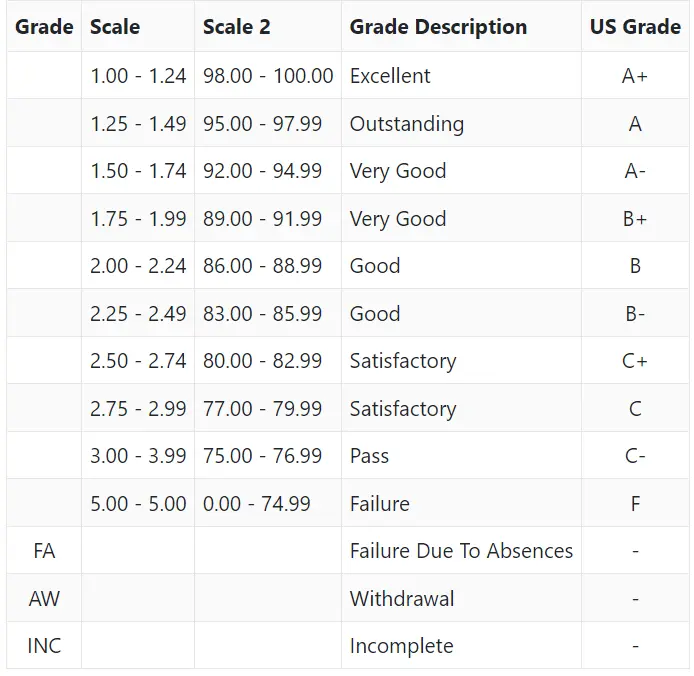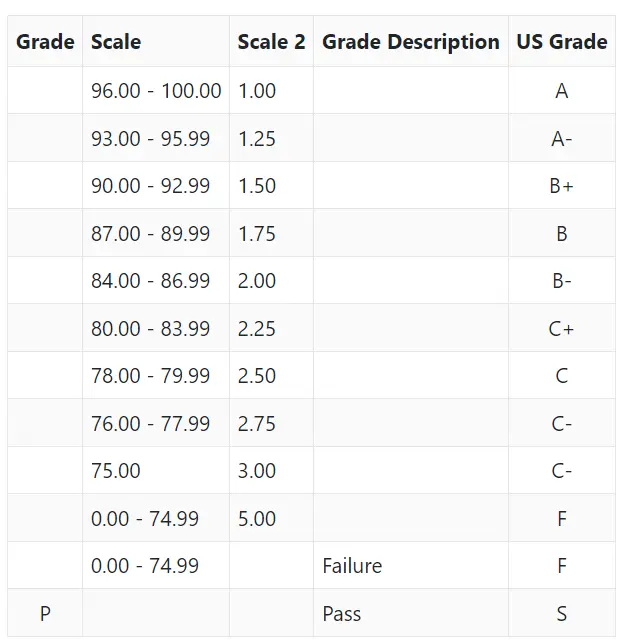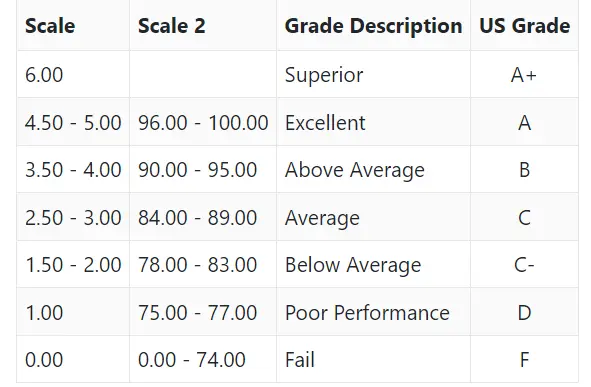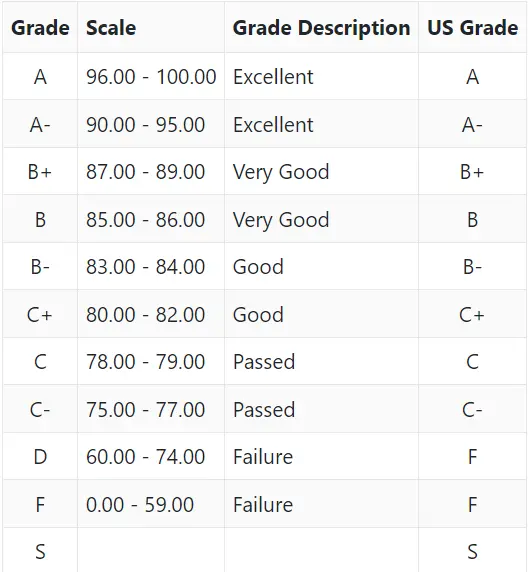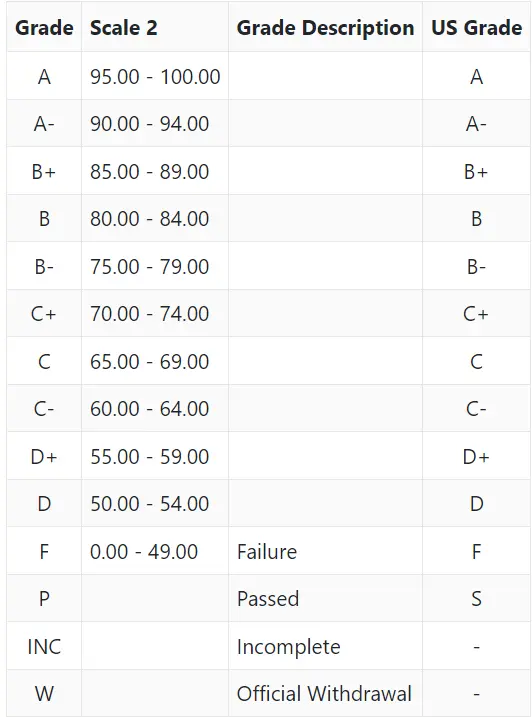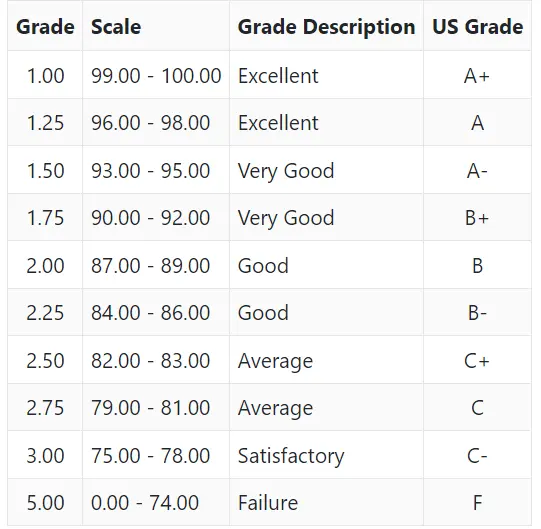
Details regarding Eastern University Grading Scale

Understanding the grading scale of an academic institution is vital for students, parents, and educators. The Eastern University Grading Scale offers clarity on academic performance, helping students set goals and measure achievements. This comprehensive guide will provide insights into the grading system, its significance, and tips for excelling under this framework.Eastern Grading System
What is the Eastern University Grading Scale?

The Eastern University Grading Scale is a standardized system that evaluates students’ academic performance. It assigns grades based on percentages or performance metrics, ensuring fair and consistent evaluations. Eastern University uses this scale to reflect students’ academic progress, guide their learning journey, and prepare them for professional success.

Key Features

1. Letter Grades and Their Meanings

The grading scale often includes the traditional A-F system:

  • A (90-100%): Excellent performance, and mastery of the subject.
  • B (80-89%): Above-average understanding with minor flaws.
  • C (70-79%): Average performance; sufficient to pass.
  • D (60-69%): Below-average, barely meeting minimum requirements.
  • F (<60%): Failing grade; insufficient understanding.

2. Grade Points

Grades correspond to grade points on a 4.0 GPA scale, typically:

  • A: 4.0
  • B: 3.0
  • C: 2.0
  • D: 1.0
  • F: 0.0

3. Plus/Minus System

To refine evaluations further, Eastern University may use a plus/minus system:

  • A- (3.7), B+ (3.3), B- (2.7), etc. This granular approach provides a nuanced understanding of performance.

4. Pass/Fail Options

For specific courses or extracurricular credits, a Pass/Fail grading system is available, focusing more on participation and effort.

Importance of the Eastern University Grading Scale

1. Clarity and Consistency

  • The grading scale ensures transparency in performance evaluation, helping students identify areas for improvement.

2. Motivational Tool

  • Grades inspire students to aim higher, fostering a culture of achievement.

3. Academic Benchmark

  • Employers and graduate schools often use grades to assess candidates, making a strong GPA essential.

How Eastern University Grading Scale Impacts Students

1. Academic Goals

  • The Eastern University Grading Scale provides a roadmap for students to track progress and set achievable goals.

2. GPA Calculation

  • Each grade impacts the overall GPA, influencing academic standing and scholarship eligibility.

3. Feedback for Improvement

  • Grades help students understand their strengths and weaknesses, enabling focused learning strategies.

Tips to Excel Under the Eastern University Grading Scale

Understand the Rubric

  • Familiarize yourself with the grading criteria for each course. Knowing how assignments and exams are weighted can help prioritize efforts.

Consistent Effort

  • Regular attendance, participation, and studying are essential for achieving high grades.

Seek Feedback

  • Utilize professors’ feedback to address gaps in understanding and refine skills.

Time Management

  • Balancing coursework, projects, and personal commitments ensures consistent performance.

Study Groups and Resources

  • Collaborate with peers, attend workshops, and use university resources to enhance learning.

Unique Features of Eastern University’s Grading Philosophy

1. Holistic Assessment

The university often includes participation, group projects, and extracurricular contributions in grades.

2. Emphasis on Growth

The Eastern University Grading Scale prioritizes improvement, rewarding consistent effort over time.

3. Flexibility for Non-Traditional Students

For students balancing work, family, or other commitments, grading policies often include leniencies like retake opportunities or extended deadlines.

Why Eastern University’s Grading Scale Matters Globally

Eastern University’s grading system aligns with international standards, making it easier for students to pursue opportunities abroad. The transparent grading approach helps foreign institutions and employers assess applicants accurately.

FAQs

1. What is the grading scale used by Eastern University?

  • Eastern University uses a standard A-F letter grading scale, often with a plus/minus system for more precise evaluation.

2. How does Eastern University calculate GPA?

  • GPA is calculated by assigning grade points to each letter grade (e.g., A=4.0, B=3.0), multiplying by credit hours, and averaging the total.

3. Does Eastern University offer a Pass/Fail option?

  • Yes, Pass/Fail grading is available for specific courses, allowing students to focus on learning without impacting GPA.

4. Can students retake courses to improve their grades?

  • Yes, Eastern University allows course retakes, with the highest grade typically replacing the previous one in GPA calculations.

5. What happens if a student receives an incomplete grade?

  • An incomplete (I) grade indicates unfinished coursework, which must be completed within a specified timeframe to avoid defaulting to an F.

The Eastern University Grading Scale is more than a metric for academic success. It is a tool for growth, a benchmark for excellence, and a stepping stone to future achievements. By understanding and adapting to this system, students can maximize their potential and build a solid foundation for their careers.

Whether you’re a current student, a prospective applicant, or an academic professional, knowing the Eastern University Grading Scale empowers you to navigate the academic journey effectively. Success starts with understanding the scale and leveraging it for personal and professional growth.


How to Stop Feeling Sleepy While Studying

Studying is crucial, but feeling sleepy while studying can disrupt focus and lower productivity. As someone who has battled sleepiness during study sessions, I understand how challenging it can be to stop feeling sleepy while studying. In this article, I’ll share proven strategies to Stop Feeling Sleepy While Studying, that have worked for me and others.how to stay awake

Understanding Why You Feel Sleepy While Studying

Feeling sleepy while studying is natural. It can happen due to:

  • Lack of Sleep: Not getting 7-8 hours of sleep impacts alertness.
  • Poor Study Environment: Dim lighting and uncomfortable seating can induce drowsiness.
  • Long Study Sessions: Prolonged focus without breaks exhausts your mind.
  • Inadequate Nutrition: Poor eating habits affect energy levels.
  • Dehydration: Even mild dehydration can cause fatigue.

Identifying the root cause helps you tackle sleepiness effectively and helps you Stop Feeling Sleepy While Studying.

Tips to Overcome Sleepiness While Studying

1. Prioritize Quality Sleep

  • Ensure you get 7-8 hours of sleep nightly. A well-rested mind retains information better. Stick to a regular sleep schedule for consistency which is a great help Stop Feeling Sleepy While Studying.

2. Optimize Your Study Environment

  • Lighting: Use bright, white light to mimic daylight.
  • Seating: Choose an ergonomic chair for proper posture.
  • Temperature: Keep the room cool but comfortable.

3. Take Strategic Breaks

  • Follow the Pomodoro Technique:
  • Study for 25 minutes.
  • Take a 5-minute active break.

4. Stay Hydrated

  • Drink water regularly to stay refreshed which assists in Stop Feeling Sleepy While Studying. Dehydration contributes to sluggishness and drowsiness.

5. Eat Energizing Snacks

Consume snacks rich in protein and healthy carbs, like:

  • Nuts
  • Fruits
  • Yogurt
  • Avoid sugary treats—they cause energy crashes.

6. Incorporate Physical Activity

Exercise stimulates blood flow and sharpens focus.

  • Take a quick walk.
  • Do light stretches.

7. Engage with Study Material

Passive reading can make you sleepy. Instead:

  • Take notes.
  • Use flashcards.
  • Teach someone else what you’ve learned.

8. Avoid Studying on the Bed

  • Your brain associates the bed with sleep. Sit at a desk to maintain alertness.

Natural Remedies to Stay Alert

1. Aromatherapy

  • Citrus and peppermint scents help increase vitality. Use essential oils or scented candles in your study space.

2. Chew Gum

  • Chewing gum keeps your brain active and reduces drowsiness.

3. Cold Water Splash

  • Wash your face with cold water to feel instantly awake.

Create a Study Routine That Works

Morning Study Routine

  • Wake up early after a full night’s sleep.
  • Do a 10-minute workout to energize yourself.
  • Eat a healthy breakfast with proteins and fibers.

Evening Study Routine

  • Avoid heavy meals before studying.
  • Limit screen time to reduce eye strain.
  • Create a to-do list to stay focused on tasks.

Effective Study Techniques to Prevent Sleepiness

1. Active Recall

  • Test yourself on what you’ve learned. This method improves memory and keeps your brain engaged.

2. Spaced Repetition

  • Review material at intervals to retain information effectively.

3. Change Subjects

  • Switching topics keeps your brain stimulated and reduces monotony.

When Coffee and Energy Drinks HelpCaffineCaffeine can be a quick fix but should be used wisely:


  • Limit intake to avoid dependency.
  • Drink coffee or tea in moderation.
  • Avoid energy drinks loaded with sugar.

Long-Term Solutions for Staying Alert

1. Maintain a Balanced Diet

  • Include vegetables, fruits, whole grains, and proteins in your meals.

2. Build a Sleep-Friendly Routine

  • Avoid screens 1 hour before bed.
  • Practice relaxation techniques like meditation.

3. Develop Healthy Study Habits

  • Consistency is key. Study at the same time daily to train your mind.

Real-Life Experiences with Staying Alert While Studying

As someone who has dealt with late-night study sessions and the struggle of staying awake, I’ve found these strategies life-changing.

One trick I swear by is active movement breaks—doing 5 push-ups or jumping jacks every hour keeps my energy up.

Another personal favorite is changing study locations. If one place feels too comfortable, I switch to a library or café for a new vibe that prevents drowsiness.

Foods That Fight Sleepiness

Incorporate these foods into your diet to sustain energy:

  • Bananas: Provide natural sugars and potassium.
  • Dark Chocolate: Offers a mild caffeine boost.
  • Eggs: Packed with protein for sustained energy.
  • Green Tea: A low-caffeine alternative to coffee.

Avoid heavy meals or greasy foods before studying, as they can make you sluggish. Avoiding those items will help you Stop Feeling Sleepy While Studying.

Embrace a Holistic Approach

Tackling sleepiness while studying requires addressing physical, mental, and environmental factors. Combine:

  1. Physical Health: Eat well, stay hydrated, and exercise.
  2. Mental Resilience: Stay motivated and stress-free.
  3. Environmental Setup: Keep your study space organized and well-lit.

The Role of Mindset in Combating Sleepiness

A positive mindset can work wonders and help you Stop Feeling Sleepy While Studying:

  • Visualize success to stay motivated.
  • Set clear goals for each study session.
  • Remind yourself why you’re studying and the long-term benefits.

How Weather Affects Sleepiness While Studying

The environment around you plays a role in your alertness which will indirectly help you Stop Feeling Sleepy While Studying:

  • Cold Weather: Makes you feel cozy and sleepy. Counteract this with warm layers but keep the room ventilated.
  • Hot Weather: Heat can drain your energy. Use a fan or air conditioning to stay cool which helps in Stop Feeling Sleepy While Studying.

FAQs

1. Why do I feel sleepy every time I start studying?

  • Feeling sleepy while studying often happens due to monotony, lack of interest, or insufficient sleep. Creating an engaging study routine and ensuring proper rest can help you Stop Feeling Sleepy While Studying.

2. Does drinking coffee or tea help prevent sleepiness?

  • Yes, caffeine in coffee or tea stimulates the brain and reduces drowsiness temporarily. However, overuse can lead to dependency and crashes, so use it sparingly.

3. Are power naps effective in combating sleepiness?

  • Absolutely! A 15-20-minute power nap can refresh your mind and improve alertness without making you groggy.

4. Can exercise help me stay awake while studying?

  • Yes, light exercises like stretching or a quick walk improve blood circulation and keep you energized during study sessions.

5. How can I stay awake while studying at night?

  • Use bright lighting, take frequent breaks, drink water, and avoid heavy meals. A consistent routine and small movement breaks also help maintain focus at night.

Feeling sleepy while studying is a common hurdle, but it’s not insurmountable. From adjusting your environment to adopting healthier lifestyle habits, every small change can make a significant difference. Stay patient, experiment with these tips, and build a routine that works for you which will directly help you Stop Feeling Sleepy While Studying.

Remember, success isn’t about how much you study—it’s about how effectively you study. Stay alert, stay focused, and keep moving toward your goals.

AI Image to Video: A Game-Changer for E-commerce Marketing

In the rapidly evolving landscape of e-commerce, businesses are continually seeking innovative ways to engage customers and boost their online presence.

One significant advancement that has reshaped e-commerce marketing strategies is the use of artificial intelligence (AI) to transform static AI images to videos. This shift is redefining how products are presented and consumed, creating more interactive and compelling shopping experiences.

This article explores how AI-driven image-to-video technology is empowering e-commerce marketers to enhance customer engagement, improve conversion rates, and drive sales.

The Evolution of Visual Content in E-commerce

Visual content has always been a cornerstone in e-commerce, deeply influencing consumer behavior and purchase decisions. High-quality images help communicate product details and build trust, yet static photos have limitations in showing a product’s full potential.

The Evolution of Visual Content in E-commerce

In response to growing consumer demand for immersive content, e-commerce brands are turning to videos, which offer a deeper, more interactive perspective of products in use, highlighting features and creating a stronger emotional connection with customers. With AI image-to-video technology, this dynamic content is now accessible and easy to produce at scale.

Understanding AI Image-to-Video Technology

AI image-to-video technology leverages sophisticated algorithms to convert still images into engaging video content. The process involves three main stages:

1. Image Analysis: The AI system analyzes various elements within an image, such as color, texture, and shape, to understand the visual aspects of the product.
2. Content Generation: Based on this analysis, the AI generates video sequences that display the product from different angles, simulate usage scenarios, and highlight key features.
3. Customization: AI tools also allow for customization, enabling users to add elements like background music, voiceovers, text overlays, and branding to tailor the video for different marketing channels and target audiences.

This process significantly reduces the time and skill required to produce high-quality videos, making it accessible to businesses of all sizes and transforming e-commerce marketing.

Enhancing Customer Engagement with AI Image-to-Video

Videos naturally capture more attention than static images, conveying more information in a shorter span. Through AI image-to-video technology, e-commerce brands can create compelling product demonstrations, tutorials, and even brand stories.

For instance, a fashion retailer might use AI to create videos showing how clothing items fit on different body types, offering a realistic view of the fit and style.

This dynamic approach not only increases time spent on product pages but also drives higher engagement rates, encouraging potential customers to explore more products.

Improving Social Media Marketing

Social media platforms favor video content due to its high engagement potential. By converting product images into videos, brands can create visually rich ads, stories, and posts that resonate with their audience on platforms like Instagram, Facebook, and TikTok.

This is where AI social media marketing strategies come into play. AI-generated videos allow marketers to keep up with the fast-paced nature of social media by providing a constant stream of relevant content that can be tailored to each platform.

This approach maximizes reach and helps brands stay top-of-mind with their target audience.

Cost-Effective Content Creation for Small Businesses

Traditional video production can be resource-intensive, requiring significant investment in equipment, software, and expertise.

AI-driven image-to-video tools offer a more affordable alternative by automating much of the video creation process.

Businesses can now generate professional-grade videos without the need for large budgets, making it particularly advantageous for small to medium-sized enterprises aiming to compete in a crowded market.

By using a reliable AI image-to-video tool, even smaller businesses can keep their content fresh and relevant while maintaining cost efficiency.

Personalization and Localization at Scale

AI enables the creation of personalized video content that can be tailored to individual customer preferences.

By analyzing customer data and browsing patterns, AI can generate videos that highlight products of interest to each unique user, creating a customized shopping experience.

Additionally, AI facilitates localization, allowing businesses to easily produce videos in different languages or adapt them to specific cultural contexts, thus expanding their reach into global markets. This personalized approach can significantly boost customer loyalty and repeat business.

Read More: New College Grading System in Philippines 2024


Integration with User-Friendly Video Applications

The integration of AI image-to-video technology with accessible video applications has further democratized content creation. Platforms like video apps offer intuitive interfaces that allow users to input images and effortlessly generate videos.

These video apps often include customizable templates, access to stock footage, and built-in editing tools, allowing businesses to produce polished, on-brand content in minutes.

By simplifying video creation, these tools free up time for marketers to focus on their strategic goals rather than the technical details of production.

Boosting SEO and Online Visibility

Incorporating video content into product listings and marketing materials not only enhances the customer experience but also improves SEO.

Search engines prioritize websites with diverse content types, including videos, leading to higher search rankings.

AI-generated videos can also increase the time customers spend on a page, reduce bounce rates, and create additional opportunities for keyword optimization.

Videos are more likely to be shared across social media, amplifying the content’s reach and driving organic traffic back to the site.

Case Studies: Success Stories in E-commerce Marketing

Fashion Retailer: A clothing brand that used AI to create videos showcasing new collections on virtual models. This innovative approach led to a 30% increase in online sales and a marked improvement in customer engagement.
Electronics Store: An electronics retailer used AI-generated videos for product demonstrations, which helped customers better understand product features and functionality, resulting in a reduction in return rates.
Home Decor Company: A home decor business that used AI to produce videos displaying furniture in various room settings, making it easier for customers to visualize products in their own spaces and increasing conversion rates.

Overcoming Challenges with AI Image-to-Video

While AI image-to-video technology provides numerous benefits, it also presents a few challenges that e-commerce businesses should consider:

Quality Control: Ensuring that AI-generated videos align with brand standards is essential. Automated content should be reviewed for accuracy and quality to maintain a consistent brand image.
Data Privacy: Leveraging customer data for personalized content requires adherence to data protection regulations to ensure customer trust.
Technology Integration: Integrating AI tools with existing e-commerce platforms may require technical expertise, but the long-term benefits often outweigh the initial setup investment.

Future Prospects of AI Image-to-Video in E-commerce

As AI technology continues to advance, the future of AI image-to-video looks promising. Expected developments include:

Real-Time Video Generation: AI may soon enable real-time video creation, allowing for instant content updates and personalized shopping interactions.
Enhanced Interactivity: Future AI-generated videos could incorporate interactive elements, enabling customers to engage directly with the video, such as rotating products or selecting color options.
Improved AI Algorithms: Continuous improvements in AI will likely lead to even more sophisticated, lifelike video outputs, enabling brands to produce high-quality, engaging videos that closely resemble human-created content.

Conclusion

AI image-to-video technology is transforming e-commerce marketing, enabling businesses to engage customers with rich, dynamic content that was once costly and time-consuming to produce.

By leveraging AI, brands can create immersive shopping experiences, improve social media engagement, and enhance their SEO efforts—all while maintaining cost efficiency.

As this technology evolves, it will continue to provide e-commerce businesses with powerful tools to connect with global audiences, build brand loyalty, and drive growth in an increasingly competitive market.

How to Make Engaging Video Presentations with a Free AI Video App?

In today’s digital world, creating engaging video presentations is essential for effective communication across various fields, including business, education, and marketing.

Free AI video apps have transformed the process, making high-quality presentation creation accessible to all, regardless of technical expertise. In this guide, we’ll explore the steps to crafting impactful video presentations using a free AI video app, with tips to ensure your content resonates with your audience.VIdeopresentation

Understanding AI Video Applications

AI video apps leverage artificial intelligence to simplify the video creation process. These tools offer features such as automated editing, voiceovers, and customizable templates, empowering users to produce polished, professional-quality videos.

By utilizing AI, these applications handle complex tasks, enabling creators to focus on their message and audience engagement rather than technical details.

One such option, the free AI video app, provides users with tools to create impactful video presentations with ease. Whether you’re a marketer, educator, or business professional, the right AI app can transform your presentations and save significant time.

Choosing the Right Free AI Video App

Selecting the right AI video app is crucial to making a successful presentation. Here are some essential factors to consider:

User-Friendly Interface: Choose an app with a simple, intuitive design, which makes it easy to navigate, especially for beginners.
Comprehensive Feature Set: Look for applications offering a range of functionalities, including text-to-video conversion, voiceovers, automated templates, and interactive media options.
Export Options: Ensure the app supports various export formats and resolutions, so your video can be easily shared across multiple platforms.Engaging Video Presentation

A versatile option to consider is a free AI video app, which enables users to create dynamic video presentations directly from their mobile devices.

Read More: AI Image to Video: A Game-Changer for E-commerce Marketing


Steps to Create an Engaging Video Presentation

Creating a video presentation with an AI video app is straightforward. Follow these steps to produce an engaging and visually appealing video:

  1. Define Your Objective
    Begin by clearly outlining your presentation’s purpose. Whether it’s to inform, persuade, or entertain a well-defined objective will guide the creation process and ensure your message resonates with your audience.
  2. Plan Your Content
    Organize your material logically, breaking it down into an introduction, main points, and a conclusion. This structure keeps your presentation coherent and helps maintain audience engagement from start to finish.
  3. Utilize AI Features
    • Text-to-Video Conversion: Input your script into the app, and the AI will generate corresponding visuals and layouts to bring your message to life.
    • Voiceovers: Use AI-generated voiceovers for narration, adding a professional touch without needing advanced recording equipment.
    • Templates and Themes: Choose from a variety of pre-designed templates to keep your presentation visually consistent and engaging.
  4. Incorporate Multimedia Elements
    Enhance your presentation by adding images, video clips, and animations. These elements can break up text and help illustrate key points, keeping the audience’s attention.
  5. Edit and Refine
    Review your presentation for clarity and visual appeal. Use the app’s editing tools to adjust timing, transitions, and effects, ensuring a polished final product.
  6. Export and Share
    Once satisfied with your presentation, export it in the desired format and resolution. Most AI video apps offer various export settings, allowing you to share the video seamlessly on social media, via email, or directly on websites.

Steps to Create an Engaging Video Presentation

Creating a video presentation with an AI video app is straightforward. Follow these steps to produce an engaging and visually appealing video:

1. Define Your Objective
Begin by clearly outlining your presentation’s purpose. Whether it’s to inform, persuade, or entertain, a well-defined objective will guide the creation process and ensure your message resonates with your audience.
2 .Plan Your Content
Organize your material logically, breaking it down into an introduction, main points, and a conclusion. This structure keeps your presentation coherent and helps maintain audience engagement from start to finish.
3 .Utilize AI Features
Text-to-Video Conversion: Input your script into the app, and the AI will generate corresponding visuals and layouts to bring your message to life.
Voiceovers: Use AI-generated voiceovers for narration, adding a professional touch without needing advanced recording equipment.
Templates and Themes: Choose from a variety of pre-designed templates to keep your presentation visually consistent and engaging.
4. Incorporate Multimedia Elements
Enhance your presentation by adding images, video clips, and animations. These elements can break up text and help illustrate key points, keeping the audience’s attention.
5. Edit and Refine
Review your presentation for clarity and visual appeal. Use the app’s editing tools to adjust timing, transitions, and effects, ensuring a polished final product.
6. Export and Share
Once satisfied with your presentation, export it in the desired format and resolution. Most AI video apps offer various export settings, allowing you to share the video seamlessly on social media, via email, or directly on websites.

Best Practices for Crafting Effective Video Presentations

To maximize the effectiveness of your video presentations, keep these best practices in mind:

Keep It Concise: Aim for brevity to maintain attention. Focus on key points, avoiding unnecessary information.
Use High-Quality Visuals: Incorporate clear and relevant visuals to support your message and enhance audience retention.
Consistent Branding: Maintain consistent colors, fonts, and logos throughout to reinforce your brand identity.
Storytelling Approach: Use storytelling techniques to make your presentation relatable and memorable.
Include a Call to Action: Encourage your audience to take specific action at the end, such as visiting your website or contacting you.

Leveraging an AI Presentation Maker for Marketing

Incorporating an  AI presentation maker into your marketing strategy can significantly enhance content delivery. AI-powered presentation makers provide customized, data-driven visuals that resonate with diverse audiences.

By using AI-generated insights, marketers can create presentations that align with their campaign objectives and audience preferences.

For instance, by integrating AI tools, marketers can quickly produce impactful presentations that highlight their products or services, maximizing consistency and relevance across all materials. This makes the AI presentation maker a valuable tool in any marketing toolkit.

The Role of AI in Modern Marketing

Artificial intelligence plays a central role in modern marketing. AI tools can analyze large data sets, offering insights into customer behavior, optimizing content strategies, and driving targeted engagement.

By utilizing AI in marketing, businesses create data-driven, personalized campaigns that lead to higher engagement and conversions.

Exploring AI marketing further reveals how artificial intelligence is transforming the way businesses connect with consumers. For example, AI can automate and personalize the marketing presentation process, allowing companies to reach audiences with content tailored to their specific interests.

Integrating AI Video Presentations into Various Fields

Education: AI video apps can help educators create interactive, visually engaging presentations for students. By utilizing multimedia and personalization features, educators can simplify complex topics and enhance student comprehension.
Business Communication: AI video presentations are invaluable in business settings, allowing teams to communicate ideas clearly and efficiently. With tools that support voiceovers and text overlays, companies can improve internal communication and training processes.
Sales Pitches: Sales professionals can use AI presentation makers to craft visually compelling pitches, which help close deals by focusing on key selling points in a dynamic format.

Challenges and Considerations

While AI video apps and presentation makers offer numerous benefits, there are a few challenges to consider:

Automated Translation Accuracy: Automated tools may not always capture cultural nuances accurately, which could lead to misunderstandings in certain contexts.
Editing for Consistency: It’s important to review AI-generated visuals and text to ensure they align with your brand’s tone and style. Small adjustments may be necessary to maintain brand consistency and clarity.

By keeping these considerations in mind, content creators can maximize the effectiveness of AI-driven presentations while ensuring accuracy and brand alignment.

Conclusion

Creating engaging video presentations has never been easier, thanks to free AI video applications. By following the outlined steps and best practices, you can produce captivating presentations that effectively communicate your message.

Embracing AI not only simplifies the process but also enhances the quality of your presentations, positioning you for success in today’s fast-paced, digital-first environment. From educators to marketers, AI presentation tools offer a powerful way to connect with audiences, enhance engagement, and drive meaningful results.

Tools and Techniques of Management Accounting

Making smart decisions is essential to operating a successful company, and management accounting is like a guide that assists you in doing just that. It offers the methods and resources required to comprehend your financial situation, make plans, and maintain the direction of your company.

If you’ve taken a Management Course, you’ll likely know how crucial these tools can be. Management accounting provides the data you need to make wise decisions, whether creating a budget, figuring out expenses, or planning for various eventualities.

In this blog, we’ll review some of the most essential tools and methods in management accounting. We’ll look at key principles that anyone exploring What is Management Accounting should know and demonstrate how these practices can improve decision-making and help you steer your company towards success.

Budgeting Tool

One of the core tools of management accounting is budgeting. It entails putting together a financial plan that projects earnings, costs, and revenues for a given time frame, usually a fiscal year.

Budgets act as the organisation’s road map, assisting management in setting financial objectives and allocating resources effectively.

Budgeting Tool

The budgeting process includes several steps:

Setting Objectives: Management starts by outlining the organisation’s long term financial and operational objectives.
Estimating Revenues: Management projects the company’s revenue based on market research and past data.
Estimating Expenses: Cost estimation is based on anticipated changes in the business environment and historical expenses.
Finalising the Budget: Senior management completes and approves the budget after creating all estimates.

Budgets are essential for performance evaluation because they offer a standard by which real financial performance can be evaluated. By comparing actual outcomes with the budget, management can find variations, comprehend their reasons, and take corrective action to ensure the company stays on course to meet its objectives.

Read More: Updated UP Grading System – University of the Philippines


Forecasting Tool

Another key tool in management accounting is forecasting, which projects future financial results using past data and market and economic factors. While forecasting is a dynamic process updated regularly as new information becomes available, budgeting offers a static financial plan.

By using forecasting management may better predict changes in the business environment and modify their plans as necessary. For example, management can take preventive steps like cutting expenses or diversifying its product offers to lessen the impact if a company expects a fall in sales owing to an economic downturn.

Forecasts are usually for financial indicators, including earnings, cash flows, expenses, and sales. Using these projections with budgets, management may make well-informed judgements about resource allocation, investment opportunities, and risk management.

Variance Analysis Tool

This tool assesses the actual values against the expected ones, the budgets. The deviation planned from the actual outcome is referred to as the variance, and this variance can be either variance gain or variance loss. They include the following: the favourable variances are occasions whereby performance surpasses expectations, while the unfavourable variances illustrate the cases whereby performance does not meet expectations.

It informs management of which factors contribute to these variances. For example, if the company is facing an adverse variance in the cost of goods sold, management can check whether the cost has risen due to higher material prices or production screw-ups, among other causes. This way, management can develop corrective actions to eliminate or reduce causes of variances and, in the process, get better results and financial position.

Key Performance Indicators [KPI] Tool

KPI are metrics used to assess a company’s financial, operational, customer, and employee productivity performance. They give management a comprehensive view of the organisation’s performance regarding its goals and objectives.

KPIs are used in management accounting to monitor and evaluate performance across many departments and business units.

Several typical financial KPI consist of:

Return on Investment [ROI]: The profitability of investments about their cost is measured by ROI.
Gross Profit Margin: The percentage of income that surpasses the cost of products sold is measured by the gross profit margin.
Cash Flow: Evaluate how much money the company can make from its activities.

Through consistent KPI monitoring, management may detect patterns, anticipate possible problems, and make data-driven choices to enhance performance and accomplish the organisation’s strategic objectives.

Balanced Scorecard Tool

The Balanced Scorecard is a strategic management tool that provides a comprehensive view of the organisation’s performance by measuring financial and non-financial metrics across four perspectives. The Balanced Scorecard is a strategic management tool that provides a comprehensive view of the organisation’s performance by measuring financial and non-financial metrics across four perspectives:

Financial Perspective: Reflects company’s financial performance in terms of profitability, revenue generation, and other critical investment ratios.
Customer Perspective: Responsible for monitoring customer satisfaction, customer loyalty and the market share of the organisation.
Internal Processes Perspective: Determines the productivity, quality, and creative performance of the organisation’s internal operations.
Learning and Growth Perspective: Measures employee training and organisation culture to ensure every employee gets the necessary training required for them to be productive in the organisation.

The features of the BSC are it provides indicators of business performance by aligning business activities with the strategic plan and view of the management. Through measurement at various organisational viewpoints, managers can make sure that they localise their decision-making and advance organisational utility.

Cost Volume Profit [CVP] Analysis Techniques

The link between expenses, sales volume, and profit can be understood using CVP analysis also called break even analysis. Using this method, management may ascertain the sales threshold at which the company will break even, reaching a point where total revenues and total costs are equal.

CVP analysis involves the following key components:

Fixed Costs: These include expenses like rent, salary, and insurance that don’t change based on the volume of production or sales.
Variable Costs: They are expenses like raw materials and direct labour that change proportionately to the volume of production or sales.
Sales Price: The cost at which goods or services are offered for purchase.
Contribution Margin: The amount available to pay fixed costs and make a profit, calculated as the difference between the sales price and variable costs.

Management can make well informed judgements regarding pricing strategies, production levels, and sales targets by determining the break-even point. In addition, CVP analysis aids in assessing the financial effects of adjustments to prices, sales volume, and costs, enabling management to plan and reduce risks.

Activity Based Costing [ABC] Techniques

ABC is a method that divides overhead expenses across goods and services according to the activities that produce them. In contrast to conventional costing techniques, which divide overhead expenses according to a single cost driver (such as direct employee hours) ABC understands that various goods and services use overhead resources in multiple ways.

ABC involves the following steps:

Identifying Activities: Management determines material handling, machine settings, quality checks, and other operations that result in overhead expenses.
Assigning Costs to Activities: Each activity is allocated overhead charges according to the resources used in that activity.
Assigning Costs to Products: The costs of each activity are then assigned to products or services based on their consumption of those activities.

ABC provides a more realistic view of the actual cost of producing a good or service, helping management make better decisions on pricing, product mix, and resource allocation. Management can find possibilities for process improvement and cost reduction by knowing what drives costs.

Standard Costing Techniques

Standard costing entails setting fixed prices for goods or services and contrasting them with actual costs to evaluate performance. These fixed expenses, sometimes standard costs, are defined by past performance, industry standards, and management projections.

Standard costing serves several purposes:

Budgeting: Financial targets and budgets are created using standard costs.
Performance Evaluation: The actual costs can be compared with the standard costs to determine the variances for operation and to evaluate them through standard costs.
Cost Control: Subsidiary costing assists the management to determine where costs are above normal and remedy the situation.

Standard costing is more applicable in manufacturing industries because it allows the management to assess the cost of production, control stocks, and analyse the effectiveness of the production line.

Scenario Planning Techniques

Scenario planning is a method for investigating many future possibilities and evaluating their possible effects on the organisation. This entails developing intricate scenarios predicated on various hypotheses including modifications to the regulatory landscape, market dynamics, and economic trends.

Management may better prepare for uncertainty by using scenario planning, which considers a variety of potential futures and creates solutions for each one.

By examining various outcomes, management can find possibilities, dangers, and backup plans to ensure the company is adaptable to change.

Conclusion

Management accounting is critical in supporting decision-making by providing pertinent and timely information, cost analysis, and performance evaluation.

Its tools and methods which include forecasting, variance analysis, budgeting, and scenario planning give managers the information and understanding they need to make choices that will propel their company forward.

Management accounting, highlighted in various free resources by The Knowledge Academy, offers the framework for choices that guarantee the long-term viability and expansion of the company, whether in budgetary planning, cost control, or future planning.

New DepEd Grading System Philippines 2024 – From K to 12

The K–12 school program uses a competency-based grading system to give grades based on how well you understand the lessons. The rules for this system are in booklets that explain how it works. All schools follow these rules from the Department of Education (DepEd).

Your grades come from the scores you get on different tests. For official documentation, students may also need a certificate of enrollment or a certificate of registration, which confirms their registration status and participation in the school’s grading system.

To pass a class, you need at least 60 points. But, on your report card, they show it as 75. So, the lowest score you should aim for in your tests is 60.

Schools want students to do their best, but a rule says the lowest score you can get on your report card is called the “floor grade.” The schools have adopted this DepEd grading system. Every three months, Grades 1-12 students are checked on tasks like tasks, written work, and big tests. The importance of each part might be different for each subject. You can use our Easy Online GWA Calculator Tool To calculate your general weighted average in your educational career.

Read Also: New College Grading System Philippines

How to record & compute learner progress?

Kindergarten Learners Progress

Special rules for checking how Kindergarten students are doing will be shared separately. In Kindergarten, instead of using grades with numbers, teachers use checklists and notes to track each child’s progress. These are based on what the Kindergarten curriculum says students should learn. Teachers should keep a collection of the student’s work, like writing samples, completed activity sheets, and artwork. This collection, called a portfolio, shows how well the students are doing and what they’ve learned. Checklists help teachers see if the child can do what’s expected, and notes or reports describe the child’s behavior, attitude, and effort in school.

Grades 1 – 12

Each school term has a big test called the Quarterly Assessment. You also get to show what you know by doing some Written Work and performing well in tasks.

There’s no set amount for how many tasks or written work you need to do. It’s important to spread them out during the term and use them to see how well you’ve learned after finishing each part (quarter).

Curriculum DepEd Grading System

The Curriculum DepEd Grading System has been in place since 2012, marking a significant shift in the education system. It’s your go-to for a comprehensive look at how students are assessed, covering upcoming grades, tasks, behavior during assessments, and quarterly details. This system stands out as a crucial and dependable source, ensuring transparency in outcomes. When it comes to your K-12 curriculum grades, the Department of Education (DepEd) Grading System has you covered.

DepEd Grading System with Honors

Getting honors in the DepEd Grading system means you did super well in school. It’s like a big thumbs up for working hard and getting awesome grades. So, when you hear someone graduated “With Honors,” it’s like they getting a special gold star for being a top-notch student!

Award Category Average Grade Range
Highest Honors 98 to 100
High Honors 95 to 97
Honors 90 to 94
DepEd Grading System with Honors

Students are honored with an Academic Excellence Award based on their overall grades.

How to Compute General Averages & Final Grades in DepEd Grading System

Step 1: Combining Grades for Student Work

It tells you the total grades for one part (like Quarterly Assessment or Written Work). Then, you change the scores into percentages to see how well you’re doing.

Step 2: Transforming Total Scores into Percentages

To figure out your Percentage Score (PS), divide your total score by the maximum possible points. Then, multiply the result by 100 to get the percentage.

PS = Student’s total score / Possible Highest Score × 100%

Step 3: Converting Percentage Score to Weighted Scores

Changing percentage scores into Weighted Scores (WS) helps highlight the significance of each component in learning various subjects. Multiply your PS by the specific weight mentioned in the table, and voila, you’ve got your Weighted Score (WS).

WS = PS × Weight of Component

Step 4: Importance of Each Part for Grades 1-10

Component LanguagesAPEsP ScienceMath MAPEHEPP/TLE
Quarterly Assessment 20% 20% 20%
Performance Tasks 50% 40% 60%
Written Work 30% 40% 20%
Importance of Each Part for Grades 1-10

(SHS Grading System) use a mix of different component weights. This table shows which subjects have what weight for each component. If you are a high School Student So it is essential to know How to Compute GWA in SHS.

Step 5: Understanding the Importance of Components in Senior High School (SHS)

Core Subjects Academic Track for All other subjects Academic Track for Research, Work immersion, Performance, Exhibits TVL/ Arts & Design Track, Sports for all other Subjects TVL/ Arts & Design Track, Sports for Research, Work immersion, Performance, Exhibits
Quarterly Assessment 25% 30% 25% 20%
Performance Tasks 50% 45% 40% 60%
Written Work 25% 25% 35% 20%
Components in Senior High School

Step 6: Adding Up Scores for Each Part to Get the Initial Grade

Afterward, this initial grade goes through a change to become the Quarterly Grade (QG). The process depends on the conversion table:

Initial Grade Transmuted Grade Initial Grade Transmuted Grade
100 100    
98.40 – 99.99 99 66.40 – 67.98 79
96.80 – 98.39 98 64.81 – 66.39 78
95.21 – 96.79 97 63.21 – 64.79 77
93.60 – 95.19 96 61.60 – 63.19 76
92.00 – 93.59 95 60.01 – 61.59 75
90.40 – 91.99 94 56.00 – 59.99 74
88.80 – 90.39 93 52.01 – 55.99 73
87.20 – 88.79 92 48.00 – 51.99 72
85.60 – 87.19 91 44.00 – 47.99 71
84.00 – 85.59 90 40.01 – 43.99 70
82.40 – 83.99 89 36.00 – 39.99 69
80.80 – 82.39 88 32.00 – 35.99 68
78.20 – 80.79 87 28.00 – 31.99 67
77.60 – 79.19 86 24.00 – 27.99 66
76.00 – 77.59 85 20.00 – 23.99 65
74.40 – 75.99 84 16.00 – 19.99 64
72.80 – 74.38 83 12.00 -15.99 63
71.20 – 72.79 82 8.00 – 11.99 62
69.61 – 71.19 81 4.00 – 7.99 61
68.00 – 69.59 80 0 – 3.99 60

Step 7: Recording Quarterly Grades

To see how to log the final tests, look at Table 6. It’s an example class record with three students in Grade 4 English for the first quarter. So the first quarter’s Class track record is taken as follows:

  Written Work (30%) Performance Task (50%) Quarterly Assessment (20%) Initial Grade Quarterly Grade
Total PS WS Total PS WS 1 PS WS
Possible Highest Score 160 100 30% 120 100 50% 50 100 20% 100 100
  145 90.63 27.19 100 83.33 41.67 40 80 16 84.86 90
  94 58.75 17.63 109 90.83 45.42 48 96 19.20 82.25 88
  54 33.75 10.13 63 52.50 26.25 29 58 11.60 47.98 71
first quarter’s Class track record

Easy Steps for Calculating Grades

  1. Add up the grades for each part.
  2. Divide the total by the highest possible grade, then multiply by 100%.
  3. Multiply the Percentage Score by the weight from Table 4 and Table 5.
  4. Add all the Weighted Scores. That’s your Initial Grade.
  5. Use the Transmutation Table to adjust the Initial Grade.

How is the student’s progress Reported?

Parents and guardians get updates on the student’s progress every quarter during a meeting with teachers. They discuss the report card, which shows how well the student is doing. You can find the grading scale and explanations in Table 10. Also, there are extra comments given at the end of each grade level.

90-100 Outstanding
85-89 Strongly Satisfactory (Passed)
80-84 Satisfactory (Passed)
75-79 Fairly Satisfactory (Passed)
Below 75 Did Not Meet Expectations (Failed)
student’s progress Reported

DepEd Promotion Guidelines

For all schools, achieving a final grade of 75 is the requirement to move on to the next level. Here’s a simple guide for your promotion or retention in DepEd:

Learners Requirements Decision
Grades 1-3 Students 75 final grade in all learning components Students must acquire passing marks in remedial classes then be promoted to the next grade.
  Didn’t accomplish all requirements in more than two components Successfully promoted to next grade levels
  Didn’t match expectations in over three components Attain the same level again
Grades 4-10 Students 75 Final Grade Successfully promoted to next grading level
  Passing the remedial class is essential otherwise considered a fail and in the same grade The student is Promoted for  Certification of Junior Higher School
  Didn’t match more than 3 areas Must retain the same grade
  Pass all Elementary learning areas Elementary Certificate is achievable
    Students must acquire passing marks in remedial classes and then be promoted to the next grade.
  Clear all Junior High School learning areas Successfully earn your certificate of Junior High School
    Promotable for the Senior High School
Grades 11-12 Students 75 Final Grade in a semester of learning area Proceedable to next semester
  Didn’t meet Expectations in a whole semester Obtain your Certificate of Senior Higher School
  Obtain your Certificate of Senior Higher School Now must clear the remedial classes otherwise considered as the failure of the subject
  Clear all subjects of Senior Higher schooling Now must clear the remedial classes otherwise considered as the failure of the subject

How Do the Filipino Child’s Important Values Show on the Report Card?

The K to 12 learning plan aims to help Filipinos develop skills for the future. It’s not just about learning; it’s also about becoming a good person. The Report Card reflects how well students are doing based on the values the Education Department finds important. Schools not under the Education Department can adjust these guidelines to match what they believe is important for their students.

Simple Guidelines for Ranking and Grading in K-12 Education

Honors Ranking for K-12

These rules help decide which students from kindergarten to 12th grade should get special recognition for their good grades and achievements. It helps to identify students who perform the best in their studies.

K-12 Grading System

This is the way teachers measure and record students’ school performance from kindergarten to 12th grade. It explains how grades are given for different subjects and activities, making sure it is fair and consistent. The K to 12 grading system includes the steps and tools teachers use to check students’ learning and skills throughout their school years.

K to 12 Classroom Assessment Guidelines

  • Undersecretaries
  • Assistant Secretaries
  • Bureau Directors
  • Regional Directors
  • School Division Superintendents
  • Heads of Public Elementary and Secondary Schools
  • Others Concerned

As part of the Enhanced Basic Education Act of 2013 (Republic Act No. 10533), the Department of Education (DepEd) is introducing new guidelines. They are for classroom assessment in the K to 12 program. These guidelines will start in SY 2015-2016 in all public schools.

Why Classroom Assessment Is Important

Classroom assessments are essential for checking how well students are learning. They help teachers adjust lessons to fit students’ needs. They also keep parents informed about their child’s progress. These tests ensure students meet the K to 12 standards.

Who Should Follow These Guidelines?

These guidelines need all public schools to follow them. Private schools can also apply them. They may change them based on their philosophy, vision, and mission. They need approval from the DepEd Regional Office.

What is Classroom Assessment?

Classroom assessment helps teachers measure how well students meet the K to 12 learning goals. It helps teachers adjust their methods. It also encourages students to reflect on their learning.

There are two main types of classroom assessments:

  • Formative Assessment (Assessment for Learning): This occurs during lessons. It helps teachers find students’ strengths and areas for improvement. It allows teachers to adjust their teaching in real-time. These assessments don’t affect final grades but guide learning.
  • Summative Assessment (Assessment of Learning): It happens at a lesson’s or grading period’s end. It measures if students met the required standards. Teachers grade and report summative assessments to students and parents.

What Do Teachers Assess?

Assessments focus on three main areas:

  1. Content Standards – What students should know.
  2. Performance Standards – The skills they need to improve.
  3. Learning competencies – specific abilities students should show to prove they understand the lessons.

Teachers use various methods to assess students. They range from simple recall to complex skills, like analysis and evaluation.

DepEd Order on Awards and Recognition (2024)

DepEd Order (2024) sets rules for recognizing student achievements. This system promotes holistic development. It celebrates students’ achievements in many areas. It encourages personal growth and leadership, not just academic success.

Types of Awards in the K to 12 Program

  1. Academic Excellence Awards: Given to students with high academic averages.
    • With Highest Honors (98-100)
    • With High Honors (95-97)
    • With Honors (90-94)
  2. Leadership Awards: For students who show strong leadership skills. They must balance academics with active involvement in school organizations and activities.
  3. Special Awards: For students excelling in the arts, sports, journalism, or community service.
  4. Conduct Awards: These awards honor students with good morals. They must discipline themselves and show respect for others.

Criteria for Awards

  • Academic Performance: Based on the students’ grade point averages.
  • Leadership and Participation: Involvement in school activities, clubs, and leadership roles is considered.
  • Good Conduct: Schools recognize students who show exemplary behavior throughout the school year.

Key Features of the deped Grading Templates:

Quarterly Grade Sheets:
These sheets are used to calculate and record student grades for each subject, based on written work, performance tasks, and exams.
 
Consolidation Sheets:
Used to compute final grades by averaging the quarterly grades of each student, providing an overall performance summary.
Key Features of the deped Grading Templates:

Conclusion

To sum it up, the DepEd grading system checks how well students are doing at different grade levels. It makes sure students are learning and getting better. This includes reaching a certain grade, joining extra classes if needed, and getting certificates as they move through school. The goal is to help students learn while keeping standards in place.

FAQs

What is the grading system used by DepEd?

DepEd uses an averaging system, combining scores from various assessments to evaluate a student’s overall performance.

How does DepEd calculate final grades?

DepEd calculates final grades by averaging scores from quizzes, exams, projects, and other assessments.

How does DepEd support students with special needs?

DepEd provides inclusive education with special programs and services tailored to meet the unique learning needs of students with disabilities.

Does 89.5 get honors in DepEd?

No, in DepEd, honors typically start at a higher grade, often 90 and above, depending on school-specific criteria.

How to Calculate Your Report Card Grades in Philippines?

Understanding how your grades are calculated can be empowering to avoid surprises on your report card. To determine your grade for a class, consider a few key factors.

First, be aware of your scores on assignments. Second, understand the grading scale your teacher is using. Lastly, find out if your teacher applies weighted grading, where different assignments carry varying levels of importance.

With this empowering knowledge, you’ll be better prepared and can steer clear of any unexpected shocks when you receive your grades. In this article, we will briefly discuss How to Calculate Your Report Card Grades in the Philippines.

Info for Students: Grading Scale, Assignment Grades, and Teacher’s Grading System

When figuring out your high school report card grades in the Philippines, remember a few things. Know the grading scale, your assignment grades, and if your teachers use a special grading system.

How to Calculate Your Report Card Grades?

Calculate Your Report Card Grades

To get your final grade, understand how much your final exam counts. Usually, it’s 20% of your total grade.

The 1st and 2nd quarters each count for 40%. To find your final grade, multiply your 1st and 2nd quarter grades by 0.40 each. Also, multiply your final exam grade by 0.20. Add these three scores to find your total report card grade.

How To Compute Grades In Card — Step-by-Step Process

Calculating grades on a report card is crucial for understanding student performance. Schools often use a formula to assess students’ test performance. Here’s an easy, step-by-step guide on how to compute grades in a report card.

1. Identify the Grading Criteria

First, you must understand your school’s grading criteria. Then, you can calculate your grades. These typically include:

  • Exams: Scores from midterms or finals
  • Quizzes: Regular quiz performance
  • Assignments: Homework or project grades
  • Participation: Classroom engagement

2. Know the Weight of Each Component

Each part of a student’s performance may have a different weight in the final grade. A typical breakdown might look like this:

  • Exams: 50% of the total grade
  • Quizzes: 20%
  • Assignments: 20%
  • Participation: 10%

Make sure to confirm the specific weights used by your school.

3. Calculate Each Section

Next, you’ll calculate each section’s weighted score. For example:

  • Exams: If a student scores 85 out of 100 on exams and the exams are worth 50%, calculate 85×0.50=42.585 \times 0.50 = 42.585×0.50=42.5
  • Quizzes: If they score 90 on quizzes worth 20%, calculate 90×0.20=1890 \times 0.20 = 1890×0.20=18
  • Assignments: For a score of 95 with a 20% weight, calculate 95×0.20=1995 \times 0.20 = 1995×0.20=19
  • Participation: With an 80 score for participation and a 10% weight, calculate 80×0.10=880 \times 0.10 = 880×0.10=8

4. Combine All Scores

Once each weighted score is calculated, simply add them together to get the final grade. Using the above example:

  • Exams: 42.5
  • Quizzes: 18
  • Assignments: 19
  • Participation: 8 Final Grade = 42.5+18+19+8=87.542.5 + 18 + 19 + 8 = 87.542.5+18+19+8=87.5

5. Convert to the Final Grade Scale

Finally, convert the total score to your school’s grading scale. Most schools use either a letter grade system (A, B, C) or a numerical system (1-5).

For example:

  • 90 – 100 = A (Excellent)
  • 80 – 89 = B (Above Average)
  • 70 – 79 = C (Satisfactory)
  • Below 70 = D/F (Needs Improvement)

Report Card Grading Criteria

Professors employ a grading scale to convert numerical scores into letter grades, ranging from ‘A’ for the highest achievement to ‘F’ for the lowest performance. Here’s the breakdown:

Letter Grade Percentage Range
A 90-100%
B 80-89%
C 70-79%
D 60-69%
F 59% or below
Grading Criteria

Comparing Weighted and Unweighted Grades

Understanding the distinction between weighted and unweighted grades is crucial. In an unweighted system, grades are assigned point values, and the final grade is determined by the total points earned. Each point carries equal value, regardless of the assignment’s overall point worth. For example:

Assignment Type Point Value per Assignment
Homework 10 points
Tests 15 points
Comparing Weighted and Unweighted Grades

In your class, your teacher decides how many points each assignment is worth, and this is outlined in the syllabus. Weighted grades, on the other hand, involve giving more importance to certain types of assignments.

Your teacher sets up categories for grading and assigns a percentage to each, ensuring the total adds up to 100 percent. This personalized method customizes the grading system to fit the specific nature of your course.

Calculate Your Simple Grade


If your teacher calculates your grades without a weighted point system, follow these easy steps.

First, note down your total points, the points you’ve earned, and the grading scale being used. Next, sum up the points you’ve earned and determine your grade using the grading scale.

Calculate Your Weighted Grade


If your professors use a weighted grading system, use this straightforward method. Gather information on your grade category, the assigned weight for each category or assignment, and the percentage you’ve earned in each category.

Multiply the percentage for each category by its assigned weight. Add up all the weighted scores for all categories and calculate the final percentage for your overall grade.

Additional Approaches for Computing Final Grades

1st Method: Unweighted Grades Calculation Manually

  • Record your quiz, assignments, homework, and classwork scores for the term.
  • Total possible scores: 18 + 15 + 07 + 09 + 03 = 52.
  • Total class scores: 05 + 20 +10 + 10 + 20 = 65.
  • Calculate your unweighted grade: 52/65 = 0.8.
  • Convert to percentage: 0.8 × 100 = 80%.
  • Determine your grade: 80 – 89 => B grade.

2nd Method: Weighted Grades Calculation Manually

  • Assign weights: Final exam (30%), four quizzes (10% each), participation (30%).
  • Multiply the weighted percentage by scores:
    • Final exam: 30 × (15/20) = 450/600.
    • Quizzes and participation are similarly calculated.
  • Sum up scores: (180+450+510+360+190) / (600+200+600+400+200) = 1690/2000 = 84.5%.
  • Compare with grading scale: 80 – 89 => B grade.

3rd Method: Unweighted Grades Calculation via Spreadsheet

  • Input data into a spreadsheet.
  • Sum up obtained marks.
  • Divide by total class scores.
  • Convert to percentage.
  • Compare final grades with corresponding grades on a scale.

4th Method: Weighted Grades Calculation via Spreadsheet

  • Create a spreadsheet.
  • Multiply student scores by weight.
  • Sum up weighted grades.
  • Compare the final grade with a grading scale.

Guidelines for Accurate Grading Calculation

  • Double-check that all obtained grades are accurately totaled.
  • Safeguard completed exams, quizzes, and assignments for future reference.
  • Consider replacing periodic grades with alternative assessments when necessary.
  • Prioritize the reliability of report card grading over semester grades for a more comprehensive evaluation.
  • Calculate your GPA or percentage based on letter grades:
Grade Percentage Range GPA
A 90-100 4.0
B 80-89 3.0
C 70-79 2.0
D 60-69 1.0
F 0-59 0.0
Guidelines for Accurate Grading Calculation

These tips ensure a thorough and accurate computation of your grades.

FAQs

How do I calculate my report card percentage?

To calculate your report card percentage, sum the points earned in each subject, divide by the total possible points, and multiply by 100.

How to calculate your average grade on report card Philippines?

In the Philippines, determine your average grade on a report card by adding the numerical values of your grades and dividing by the number of subjects.

How do I calculate my final grade percentage?

Calculate your final grade percentage by adding the weighted scores of each assessment, dividing by the total possible points, and multiplying by 100.

Conclusion

When it’s time to Calculate Your Report Card Grades just add up your scores, divide by the maximum points, and multiply by 100. Think of it as your academic scoreboard, showing you how smoothly you’re sailing through those grades. So, dive in, do the math, and cheer for your academic wins.

How to Compute GWA in Senior High School | Easily Calculate Your GWA is SHS

Welcome to this comprehensive guide on how to compute GWA in Senior High School. As a student, understanding your academic performance is crucial, and your GWA plays a significant role in determining your overall progress. Whether you’re aiming for honors or scholarships, knowing how to calculate your GWA accurately is essential.

The GWA calculator is a useful tool for Senior High School students to accurately compute their General Weighted Average, aiding in tracking academic progress. In this article, we’ll dive deep into the intricacies of the grading system, provide step-by-step instructions on GWA computation, and share useful tips to help you achieve the best possible results.

Understanding the Grading System in Senior High School

Before we delve into GWA computation, it’s essential to grasp the grading system used in Senior High School. The Philippine educational system typically employs the 10-point grading scale, where numerical grades are translated into letter grades. Each letter grade corresponds to a specific range of numerical values, indicating the level of achievement for a particular subject.

Here’s a breakdown of the 10-point grading scale:

Numerical Grade Equivalent Letter Grade Description
98-100 A+ Outstanding
95-97 A Excellent
90-94 A- Very Good
85-89 B+ Good
80-84 B Above Average
75-79 B- Satisfactory
70-74 C+ Fair
65-69 C Acceptable
60-64 D Needs Improvement
Below 60 F Failed

What is GWA in Senior High School?

In senior high school, “GWA” stands for “General Weighted Average.” It is a number. It shows a student’s academic performance over a set period, usually a semester or a school year. The GWA is calculated by weighting each subject’s grade. The weight is based on its credit units or academic load. The higher the grade in an issue and the more credit units it carries, the more it contributes to the student’s GWA.

How to Compute for GWA:

To calculate your Grade Weighted Average (GWA), assign values to your grades. Then, find the weighted average. Multiply each course grade by its credit hours. Sum these values for all courses, then divide by the total completed credit hours. This method offers a unique, brief way to assess your academic performance.

Step-by-Step Guide to Computing GWA in SHS

Now that you have a clear understanding of the grading system, let’s proceed with calculating your GWA. Here’s a step-by-step guide to help you through the process:

Step 1: Gather Your Grades

The first step is to gather all your subject grades for the specific period you want to calculate the GWA. This could be for a semester, a school year, or a particular set of subjects.

Step 2: Convert Letter Grades to Numerical Equivalents

To compute your GWA, you need to convert each letter grade to its equivalent numerical value using the 10-point grading scale mentioned earlier.

Step 3: Compute the Total Credit Units

For each subject, identify the corresponding credit units. Credit units represent the weight or value assigned to each subject based on its complexity and the number of hours it meets per week.

Step 4: Calculate the Total Grade Points

To calculate the total grade points, multiply the numerical equivalent of each grade by the credit units of the subject.

Step 5: Sum up the Grade Points and Credit Units

Add up all the grade points and credit units obtained from Step 4. This will give you the total grade points and total credit units.

Step 6: Determine Your GWA

To compute your GWA, divide the total grade points by the total credit units. The result is your General Weighted Average (GWA) for the specific period.

Note: You can also compute your GWA with Excel

How to Calculate GWA in Grade 11 and Grade 12

Calculating your General Weighted Average (GWA) in Grades 11 and 12 is easy. Start by gathering your final grades for all subjects. Next, add these grades together to get the total score. Then, divide the total by the number of subjects. This will give you your average, as each subject is equally important.

For example, if your grades are 90 in math, 88 in science, 92 in English, and 85 in Filipino, add them up to get 355. Divide that by 4 (the number of subjects), which gives you a GWA of about 89 after rounding. This process is the same for both grades. It helps you track your academic performance.

Tips for Accurate GWA Computation

Achieving an accurate GWA computation is crucial for tracking your academic progress. Here are some tips to help you get it right:

Tip 1: Keep Track of Your Grades

Maintain a record of your subject grades throughout the academic year. This will make it easier for you to gather the necessary information when calculating your GWA.

Tip 2: Double-Check Conversion

When converting letter grades to numerical equivalents, double-check your conversions to avoid errors in computation.

Tip 3: Pay Attention to Credit Units

Ensure that you accurately identify the credit units for each subject, as this directly affects the GWA calculation.

Tip 4: Seek Assistance from Teachers or Advisors

If you encounter difficulties or uncertainties in computing your GWA, don’t hesitate to seek guidance from your teachers or academic advisors.

Tip 5: Set Academic Goals

Use your GWA as a benchmark for setting academic goals. Strive to improve your GWA each term and challenge yourself to excel academically.

Tip 6: Take Care of Your Overall Well-Being

Remember that academic performance is not the sole measure of your worth. Take care of your physical and mental well-being to achieve a balanced and fulfilling student life.

FAQs

Can I Compute My GWA for Specific Subjects Only?

Yes, you can calculate your GWA for specific subjects or sets of subjects, such as those taken within a semester or a school year.

How Often Should I Compute My GWA?

It’s advisable to compute your GWA at the end of each academic term to monitor your progress and identify areas for improvement.

Does the GWA Calculation Include Non-Academic Activities?

It’s advisable to compute your GWA at the end of each academic term to monitor your progress and identify areas for improvement.

Can I Still Improve My GWA After It’s Calculated?

Yes, your GWA is not fixed and can be improved over time as you achieve better grades in your subsequent academic terms.

Do Colleges and Universities Consider GWA in Admissions?

Yes, GWA is a crucial factor considered by colleges and universities during the admissions process. It reflects your academic competence and potential.

Is GWA Calculation Different in Colleges and Universities?

The GWA calculation in colleges and universities may vary slightly from the senior high school system. It’s best to inquire about the specific method used in the institution you plan to attend.

How to compute GWA in SHS?

Calculating your GWA (General Weighted Average) in Senior High School is simple. You just add up the final grades for all your subjects, then divide the total by the number of subjects. Since each subject is equally important, this shows your overall academic performance. This calculation shows how all your subjects affect your success.


Conclusion

Calculating your GWA in Senior High School is an essential process that helps you gauge your academic performance and set educational goals. By understanding the grading system, following the step-by-step guide, and considering helpful tips, you can ensure an accurate GWA computation. Remember that your GWA is not the sole measure of your capabilities, so maintain a healthy balance between academic pursuits and overall well-being.

Importance Of Transcript Of Records Philippines – Request for Documents

When you’re getting ready to study abroad, whether it’s just for a bit or a whole degree, you’ll have some paperwork to do. One important paper is your school records, which are like a report card. It’s connected to another paper called Your Learning Plan. This plan is like a to-do list for the classes and stuff you need to do while you’re away.

Make sure you fill in your report card info correctly. The learning plan needs to be signed and okayed by your home school and the school you’re visiting. If there are any changes, all three (both schools and you) need to agree on them. Think of the Learning Agreement and transcript of records as your academic badges for studying abroad. They say, “Hey, I did this work, and here’s how many credits I earned!”

Check Out: GWA Calculator

What is a Transcript Of Records?

A Transcript of Records is an official document. It lists a student’s academic achievements. It includes information about the courses completed, grades received, and credits earned. The college or university usually provides the TOR. It shows academic progress. It is often needed to recognize qualifications in the Philippines and abroad.

Think of the Transcript of Records as your school report for applying to a foreign university. If you’re in an exchange program, you’ll also get another report at the end of your studies from the university where you took classes. This report lists all the classes you took, the tests you passed, and the points you earned. It includes details like the class code (a specific code for each class), the class title, how long the class lasted, your test grade (which is important for getting your points), and the credits you earned.

If your home university doesn’t use the same system, the report should explain how things work. When sending the report online, you can explain the grading scale used during your study. This explanation should make clear which grades are the best and worst. Your school records can be filled out by you, your home school, or the foreign school’s office, depending on their rules. Usually, the report is completed after passing all the tests listed in the Learning Agreement, and usually, only the passed classes will be included, not the ones you didn’t pass.

How To Get Transcript Of Records Philippines

Getting your transcripts in the Philippines is easy! Just follow these simple steps:

  1. Your academic info is private and will only be shared when you ask for it. Head to the University Registrar’s Office, hand in your student clearance, and fill out a transcript request.
  2. Each page of your transcript costs PhP50.00 to prepare.
  3. If you’re a graduate, don’t wait! Ask for your transcripts ASAP to avoid any unnecessary delays.

A quick tip: Thanks to Republic Act No. 11261, there’s a small government fee for getting your hands on this important document.

Here is a Certified Copy Transcript Of Records

Certified Copy Transcript Of Records

What Does a Transcript of Records Philippines Include?

A transcript can look different depending on where you go to school. But generally, it will have:

  1. Your name and school
  2. Your classes and when you took them
  3. Names of your classes
  4. How long your classes were
  5. Grades or scores you got
  6. A stamp from the school
  7. Someone important’s signature

How to Request a Transcript of Records Philippines?

If you want to study abroad in the Philippines, you’ll need to ask for your school papers. Here’s an easy guide:

  1. Contact Your School: Start by talking to your school’s office. Ask them what you need to do to get your papers. You can check their website or just call them.
  2. Fill Out a Form: Schools usually have a special paper request form. Fill it out with your name, student ID, and contact info.
  3. Pay Money: Sometimes, you have to pay a bit of money to get your papers. Ask your school how much and how to pay. It could be cash, a bank payment, or online.
  4. Get Permission, If Needed: If someone else is picking up your papers, the school might ask for permission. Write a note saying it’s okay if someone else gets them for you.
  5. Wait for Your Papers: It takes some time for your papers to be ready, usually a few days or weeks. Plan early if you have a deadline.
  6. Pick Up or Deliver: When your papers are ready, you can either go get them at school or ask for delivery through a mail service. If you pick them up, bring an ID.
  7. Check Your Papers: Before you leave or get them from the mail, check your papers. Make sure all your grades and info are correct.
  8. Ask for More Copies: If you need more than one copy, ask for them all at once to save trouble later. You might have to pay extra.
  9. Keep Your Papers Safe: Your papers are important, so keep them in a safe place. You might need them for jobs, more school, or moving to another country. Safe papers mean no worries.

When is the right time to request a Transcript of Records?

Typically, you’d leave obtaining the transcript until later in your exchange program because it encompasses the exams you’ve taken, whether you’ve passed or not.

To expedite the process of getting your Transcript of Records ready, you can take the initiative. After successfully passing an exam, approach your professor and request them to note down your results in the “Local Grade” section of the rough copy. Later, you can fill in the remaining sections with the necessary information.

Once your Transcript of Records is filled out, simply submit it, along with the other required application documents, to your home International Office.

Important Components Of Transcript of Records

# Component Explanation
1. Student’s Info Full name, ID number, and other personal details.
2. College/University Details College/university name, transcript issue year, dean/director’s name, and the official seal.
3. Completed Courses Details on each completed course, including course number, title, credit points, grades, and semesters taken.
4. Grade Points Presentation of grades achieved and corresponding grade points.
5. Credit Points Total credits earned during the student’s studies.
6. Grade Point Average Overall grade point average, combining all grades.
7. Academic Status Information on the student’s academic standing, such as good standing, expulsion, or temporary suspension.
8. Additional details like degrees, academic awards, or special programs may be listed in this section. Additional details like degrees, academic awards, or special programs that may be listed in this section.
Components Of Transcript of Records

See the Philippines Transcript of Records Table for all your academic records and where to get them, along with the fees.

NO Academic Record Issuing Office Processing Period Fee
1. Diploma Registrar’s Office Twelve Working Days PHP 450.00
2. Transcript of Records      
  Finished Studies Registrar’s Office Twelve Working Days PHP 250.00
  Unfinished studies Registrar’s Office Twelve Working Days PHP 200.00
3. Honorable Dismissal Registrar’s Office Seven Working Days PHP 80.00
4. Certification of Graduation Registrar’s Office Three Working Days PHP 65.00
5. Certification of Medium Instruction Registrar’s Office Three Working Days PHP 65.00
6. Certification of Weighted Average Registrar’s Office Three Working Days PHP 65.00
7. Authentication of Records Registrar’s Office One Day* PHP 50.00
8. Course Descriptions Dean’s Office Varies by College Varies by College
9. Course Syllabi Dean’s Office Varies by College Varies by College
Transcript of Records

What should I do if I need to leave and my Transcript of Records is not yet prepared?

No need to stress if your Transcript of Records isn’t ready when you have to leave, especially for Erasmus students. Typically, exams happen in the final weeks of the Erasmus period, and it might take a bit to get all the grades sorted for the transcripts. But don’t worry!

Your home or host institution can provide an official interim transcript, showing your grades up to that point. Just send an email to your professors, asking them to directly send the results to the International Office, which will complete the document for you. Once your exam results are registered, three hard copies of your transcript will be sent to the International Office. Your home university will then forward one or two hard copies directly to you.

Understanding the Legal Side of Educational Transcripts

Transcripts of Records, those papers summarizing your education, come with some important rules. Here’s a simple breakdown:

  1. Be Honest: Don’t fake it. Keep your academic records real.
  2. Keep it Private: Your grades are your business. Privacy laws make sure of that.
  3. Verify Yourself: Confirm your records. Make sure they’re yours.
  4. Job Matters: Your transcripts can affect your job opportunities.
  5. No Cheating!: Trying to trick with fake records is a big no-no.
  6. Check Accreditation: Make sure your school is recognized. It matters.
  7. No Fake Transcripts: Don’t create fake records. It’s against the law.
  8. Access Rules: Understand who can see your transcripts.
  9. Hold on to Records: Keep your records safe for a while.
  10. No Discrimination: Your grades shouldn’t lead to unfair treatment.

Remember, these rules can change depending on where you are. So, always follow the education laws in your area. Messing with your transcripts can land you in serious trouble.

Understanding the European ECTS System’s Transcript Records

The Transcript of Records in the European ECTS (European Credit Transfer and Accumulation System) is like the academic passport for students in Europe. It’s a standardized document that every European university uses. Here’s a quick rundown of what it includes:

  1. Personal Info: Just the basics about you.
  2. School Details: Info about the university you’re attending.
  3. Your Program: What you’re studying.
  4. When and What: Academic calendar and details about each course.
  5. Credits Earned: The ECTS credit system in action.
  6. Grading Scale: How they measured your success.
  7. Decoding the Transcript: A key to understanding all the info.
  8. Official Stamps: Signatures and seals make it legit.
  9. How Well You Did: Your grades and results.

It’s like your educational ID, So Keep it Safe.

Conclusion

In the Philippines, your school grades paper Such as Transcript of Records is super important. It tells about your studies and helps with things like studying in another country or getting a job. This paper shows what degree you got, your grades, and the percentage you got. You can use a special calculator to find this out. Keeping this paper updated is like having a secret code for schools and jobs to know how good you are at your studies. Just make sure to keep it safe, and it can open doors for you.

FAQs

How do I get a transcript of a document?

Request a transcript from the issuing institution or use online platforms for document retrieval.

What is in a Transcript of Records?

A Transcript of Records includes details like degree, grades, and academic achievements.

What is OTR in college?

OTR in college typically refers to an Official Transcript of Records.

What is the meaning of Tor in school?

In school, TOR stands for Transcript of Records, summarizing academic performance.

What is the difference between a transcript and a certificate?

A transcript details the academic history, while a certificate confirms completion of a specific program or course.

How to Request a Transcript of Records (TOR) in School?

To request a Transcript of Records (TOR) from your school, check its website for the requirements. Or, ask the registrar’s office. Gather the necessary documents, such as your ID, and complete the TOR request form. Submit the form and documents to the registrar, either in person or online, and pay any fees if needed. After processing, you will receive your TOR by mail or for pick-up. Following these steps will help you easily obtain your transcript of records.

How to Compute GWA in Excel: A Comprehensive Guide with GWA Calculator Excel

Welcome to our comprehensive guide on how to compute GWA in Excel! Whether you’re a student striving to monitor your academic performance or an educator looking to calculate your students’ General Weighted Average accurately, this article is designed to help you navigate the process effortlessly.

Calculating your GWA is important for academic success, as it reflects your overall performance in school, considering both your grades and their corresponding credit units. Excel, being a powerful spreadsheet tool, offers an efficient and convenient way to perform these computations. As an essential tool for academic planning and assessment, the GWA Calculator in Excel plays a vital role in helping students achieve their educational goals.

In this article, we’ll take you through each step of the Excel GWA calculation process and provide valuable insights and tips to enhance your understanding. Let’s dive in!

How to Compute GWA in Excel

To compute your GWA in Excel, follow these Easy steps:

Step 1: Gather the Necessary Data

Before diving into the calculation process, ensure you have all the required data. Gather your subject names, corresponding grades, and their respective credit units. This information is essential for accurate GWA computation.

Step 2: Assign Grade Points

Assign the appropriate grade points to each grade in your academic system. Different educational institutions may have varying grading scales, so make sure to use the correct one. For instance:

Grade Grade Points
A 4.0
B+ 3.5
B 3.0
C+ 2.5
C 2.0
D 1.0
F 0.0
How to Compute GWA in Excel

Step 3: Calculate Subject-Weighted Scores

Now, let’s compute the weighted score for each subject. To do this, multiply the grade points by the credit units for each subject. For example, if you scored an A (4.0 grade points) in a 3-credit unit subject:

Weighted Score = Grade Points (4.0) x Credit Units (3) = 12.0

Step 4: Sum the Weighted Scores and Total Credit Units

To find your Total Weighted Score, sum up all the weighted scores from Step 3. Simultaneously, calculate your Total Credit Units by adding the credit units of all your subjects.

Step 5: GWA Formula In Excel

You can use the GWA formula in Excel to accurately calculate your grades. Finally, compute your GWA by dividing the Total Weighted Score by the Total Credit Units.

GWA = Total Weighted Score ÷ Total Credit Units

Congratulations! You’ve successfully calculated your GWA in Excel!

You May Also Compute your GWA for Senior High School.

Example: How to Calculate GWA Using Excel

Follow these simple steps to calculate grades in Excel:

  1. Set Grading Criteria: Define the grading standards based on the student’s marks. For example, decide that the highest marks get an “A” grade, and the lowest get a “D” grade.
  2. Calculate Total Marks: Add up the total marks earned by each student.
  3. Find Percentage: Calculate the percentage achieved by each student.
  4. Apply Nested IF Formula: Use the nested IF formula to assign grades based on the established criteria. For instance, if the percentage falls within a certain range, assign the corresponding grade (A, B, C, or D).

Read Also: How to Compute GWA Grade in College

Watch this detailed video to make things easier for you

https://www.youtube.com/watch?v=7MEBeOdidvk&t=21s&ab_channel=TrishaMaeChu

Here’s a simple Excel formula to calculate grades based on percentage:

=IF(H2>80%, “A”, IF(H2>70%, “B”, IF(H2>60%, “C”, “D”)))

1. This formula means that if your percentage is higher than 80%, you fall into the Grade A range.

2. If your percentage is between 70% and 80%, you fall into the Grade B range.

3. For percentages between 60% and 70%, you’re in the Grade C range.

4. Anyone with a percentage lower than 60% will be assigned Grade D.

You can easily apply this formula to other cells by dragging it, making it convenient to calculate grades for multiple students.

Tips for Accurate GWA Computation

  1. Double-check Data Entry: Ensure that you accurately input all the grades and credit units to avoid calculation errors.
  2. Use Excel Formulas: Instead of manually computing each step, employ Excel formulas to streamline the process and minimize mistakes.
  3. Regularly Update Grades: Keep your academic records up-to-date to get an accurate reflection of your performance.
  4. Review Grading Scale: Verify the grade points assigned to each grade based on your institution’s grading scale.
  5. Seek Expert Assistance: If you encounter difficulties or discrepancies, don’t hesitate to consult your academic advisor or instructors for guidance.

FAQs

Can I use Excel for GWA calculation even if my school uses a different grading scale?

Yes, you can. Ensure you adjust the grade points in Step 2 to match your school’s grading scale.

Is it possible to compute GWA if I have incomplete grades or subjects?

Yes, you can still compute your GWA if you have incomplete grades or subjects. Simply exclude them from the calculation and focus on the available data.

Can I calculate my GWA for a specific semester using Excel?

Absolutely! Follow the same steps but consider only the subjects and grades from the particular semester you want to calculate the GWA for.

What’s the significance of GWA in academic settings?

GWA is a vital metric that reflects your overall academic performance and may influence opportunities such as scholarships and academic honors.

Is GWA the same as GPA (Grade Point Average)?

While similar in concept, GWA and GPA may differ in how they are calculated and the grading scale used. GWA is commonly used in some educational systems, while GPA is more prevalent in others.

Conclusion

In conclusion, knowing how to compute GWA in Excel is an invaluable skill for students and educators alike. By accurately calculating your GWA, you gain valuable insights into your academic performance and identify areas for improvement. In this guide, we’ve provided a step-by-step process, and valuable tips, and addressed frequently asked questions to ensure you have a comprehensive understanding of the topic.

So, go ahead and use Excel’s powerful capabilities to calculate your GWA effortlessly and make informed decisions about your academic journey. Remember, your GWA represents your hard work and dedication, so take pride in your accomplishments.

GPA vs. GWA – Learn the Main Difference Between GWA And GPA

As students begin their education, they encounter many confusing acronyms and systems. Of these, GPA and GWA are the most important. They are key indicators of a student’s academic performance. Knowing the differences between these two metrics is vital. It helps with decision-making and academic success.

This article will explore the nuances of GPA vs. GWA. We will also discuss their impact on academic performance. Lastly, we will share insights from experts and credible sources. We will also introduce a GWA calculator. It will help students to compute their academic standing and set realistic goals.

Key Difference Between GPA and GWA

Students must know the difference between GWA and GPA. It’s key to managing their academic performance. GPA measures individual course grades, assessing each subject separately. GWA, on the other hand, combines all your grades into one score. It uses that to measure your overall academic performance. Think of GPA as focusing on each step. GWA shows your full educational progress. Both GPA and GWA are vital for assessing your success. Each uses a different method to reflect your achievements.

Here’s a simple table that shows the main differences between GPA and GWA

Criteria GWA (General Weighted Average) GPA (Grade Point Average)
Full Form General Weighted Average (Philippines) Grade Point Average (International)
Meaning A method used in the Philippines to assess academic performance A widely used system that calculates academic scores globally
Grading Scale 1.00 (highest) to 5.00 (lowest) 4.0 (highest) to 0.0 (lowest)
Weighting System Considers the number of units or credit hours per subject Typically treats each course equally
Calculation Formula (Grade × Units) ÷ Total Units (Grade Points × Credit Hours) ÷ Total Credit Hours
Regions of Use Philippines Global (USA, Canada, etc.)

GPA vs GWA Meaning

Definition of Grade Point Average (GPA):

The GPA, or Grade Point Average, is a widely recognized metric. It is used mainly in the U.S., Canada, and Australia. It provides a standardized way to measure a student’s overall academic performance. GPA is based on a student’s letter grades and their grade points.

Definition of General Weighted Average (GWA):

GWA, or General Weighted Average, is more commonly used in the Philippines and some other Asian countries. GWA calculates your grade by combining all your subject grades, giving more weight to subjects with more units.

Is GPA and GWA the same?

Although GPA and GWA may seem similar at first glance, they represent distinct academic measures. GPA stands for “Grade Point Average,” a standardized numerical representation of a student’s average performance across all courses in a specific academic period.

On the other hand, GWA stands for “General Weighted Average,” which is a similar concept but often used in different educational systems or institutions to calculate a student’s overall performance throughout their academic journey. Both test academic achievement. But, their methods and purposes may vary. We must understand these differences. They are key to navigating education and knowing one’s academic standing.

Understanding The Difference Between GWA and GPA Calculation

GPA Calculation: A Straightforward Approach

To calculate GPA grade, each course a student takes is assigned a certain number of credit hours. These credit hours represent the amount of work and academic rigor required for the course. After completing a course, the student receives a letter grade (e.g., A, B, C, D, or F), and each letter grade corresponds to a specific grade point (e.g., A = 4.0, B = 3.0, C = 2.0, D = 1.0, and F = 0.0).

To find your GPA, use this formula:

GPA = (Total Grade Points ÷ Total Units)

To determine the average GPA, the grade points for all completed courses are added together, and then the total is divided by the sum of credit hours attempted. The result is a numerical value typically ranging from 0.0 to 4.0, with 4.0 being the highest achievable GPA.

GPA Letter Grade Description
4.0 A Excellent
3.7 A- Very Good
3.3 B+ Good
3.0 B Above Average
2.7 B- Slightly Above Average
2.3 C+ Satisfactory
2.0 C Average
1.7 C- Below Average
1.3 D+ Poor
1.0 D Barely Passing
GPA Calculation

GWA Calculation: A Weighted Perspective

Unlike GPA, GWA follows a weighted grading system. Each course is assigned a specific number of credit units, and alongside the letter grade, an additional weight factor comes into play. The weight factor indicates the relative importance of a particular course in a student’s academic journey.

For Calculating GWA, use this one:

GWA = (Total Grade Points ÷ Total Units)

Grade Point Grade Letter Equivalence GPA Equivalence Description
1 A+ 99-100% 4.000 Excellent
1.25 A 96-98% 3.625-3.999 Good
1.5 A- 93-95% 3.250-3.624 Very
1.75 B+ 90-92% 2.875-3.249 Good
2.0 B 87-89% 2.500-2.874  
2.25 B- 84-86% 2.125-2.499  
2.5 C+ 81-83% 1.750-2.124 Satisfactory
2.75 C 78-80% 1.375-1.749 Pass
3.0 C- 75.00-77.74% 1.000-1.374  
4.0 Conditional
5.0 F Below 60% 0.000 Fail
INC Incomplete
GWA Calculation

To calculate GWA, the sum of (credit units multiplied by the grade equivalent) for all completed courses is divided by the total number of credit units completed. The resulting figure represents the GWA, which typically falls from 1.00 to 4.00, with 1.00 being the highest achievable GWA.

The Impact on Academic Performance: GPA vs GWA

GPA: Reflecting Academic Standing

GPA serves as a valuable indicator of a student’s overall academic standing and achievements. It provides insight into a student’s ability to perform well in different subjects and courses. A high GPA can open doors to various opportunities, including scholarships, internships, and admission to prestigious academic institutions.

However, the GPA system may have its limitations. It doesn’t consider the weight or difficulty level of individual courses and may not fully capture a student’s true potential. This is where GWA comes into play.

GWA: Emphasizing Course Difficulty

GWA takes into account the weight or difficulty level of each course, providing a more comprehensive view of a student’s academic performance. Courses with higher weight factors have a more substantial impact on the GWA, highlighting a student’s ability to excel in challenging subjects.

While GWA provides a more nuanced understanding of a student’s academic capabilities, some argue that it might not be as widely recognized or standardized as GPA in international settings.

Making Sense of the Conversion: GPA to GWA and Vice Versa

Converting GPA to GWA

As students explore academic opportunities abroad or apply to institutions that use the GWA system, they may need to convert their GPA to GWA. This conversion typically involves understanding the grading scales and weight factors used in the GWA calculation.

It’s essential to note that the conversion process may vary from one institution or country to another. Students should seek guidance from academic advisors or refer to official conversion tables provided by educational institutions.

Converting GWA to GPA

Converting Grade Weighted Average (GWA) to Grade Point Average (GPA) is a fundamental process in educational institutions to evaluate a student’s overall academic performance. The GWA is typically a numerical representation of a student’s average grades across all courses, factoring in the weight or credit hours assigned to each course. On the other hand, GPA is a standardized measure that converts the GWA into a common scale, allowing for easier comparison of academic achievements between students.

To perform the conversion, first, each letter grade received in different courses is assigned a specific numerical value, usually on a 4.0 scale. For instance, an “A” might correspond to 4.0, a “B” to 3.0, a “C” to 2.0, and so forth. Then, the numerical values of all the grades earned in courses are added together, and this sum is divided by the total number of credit hours or courses attempted. The resulting quotient is the GPA.

For example, if a student scored “A” (4.0) in a 3-credit course, “B+” (3.3) in a 4-credit course, and “A-” (3.7) in a 2-credit course, the total grade points would be (4.0 x 3) + (3.3 x 4) + (3.7 x 2) = 45.1. Considering the total number of credits attempted (3 + 4 + 2 = 9), the GPA would be 45.1 / 9 = 5.01.

The Impact of GPA vs. GWA on Your Future Endeavors

GPA: Global Recognition and Opportunities

As GPA is widely used in various countries, it enjoys a high level of recognition on an international scale. Many universities, employers, and scholarship programs around the world are familiar with the GPA system, making it easier for students to showcase their academic achievements and qualifications.

GWA: Navigating Local Opportunities

In the Philippines and some other Asian countries, GWA is the standard measure of academic performance. For students planning to pursue higher education or career opportunities locally, GWA holds significant importance.

Students need to be aware of which system (GWA vs GPA) is recognized and preferred by the institutions or employers they intend to apply to, ensuring they meet the specific requirements.

Frequently Asked Questions (FAQs)

What’s the minimum GPA required for admission to top universities in the United States?

The minimum GPA required for admission to top universities in the United States varies depending on the institution and the specific program. Generally, highly competitive universities may look for GPAs above 3.5 on a 4.0 scale, while other institutions may consider GPAs closer to 3.0.

Can a high GWA guarantee a successful career in the Philippines?

While a high GWA is an excellent achievement and may open doors to more opportunities, it does not guarantee a successful career on its own. Success in one’s career also depends on various other factors, such as skills, experience, networking, and determination.

Are there universities that consider both GPA and GWA during admissions?

Yes, some universities with diverse student populations may consider both GPA and GWA during the admissions process. This allows them to assess applicants from different educational backgrounds more comprehensively.

Does a low GPA or GWA mean a student is not intelligent?

No, a low GPA or GWA does not necessarily mean a student is not intelligent. Academic performance is influenced by various factors, and some students may excel in non-academic areas or face challenges that affect their grades.

How can a student improve their GPA or GWA?

Improving GPA or GWA requires dedication, time management, seeking help from professors or tutors, and being proactive in one’s studies. Identifying areas of weakness and implementing effective study strategies can lead to better academic performance.

Are there other academic performance metrics used in different countries?

Yes, there are various academic performance metrics used worldwide, such as CGPA (Cumulative Grade Point Average), SGPA (Semester Grade Point Average), and CQPI (Class Quality Point Index).

How Do You Calculate GPA and GWA?

GWA is calculated by weighing grades based on credit hours and dividing by total credits. GPA uses a point system, averaging numerical values for each grade.

Conclusion

In conclusion, GWA and GPA are essential metrics that significantly assess a student’s academic performance. While GPA is widely recognized and used in many countries, GWA provides a more comprehensive view, considering the weight of individual courses. Both systems have their merits and are relevant within their respective contexts.

As students explore educational opportunities, understanding the distinction between GPA vs. GWA is vital for making informed decisions. Additionally, being aware of the specific requirements of institutions and employers can help students navigate their academic and professional paths successfully.

Remember, academic performance is just one aspect of a student’s journey. Emphasizing personal growth, acquiring valuable skills, and maintaining a thirst for knowledge are equally important on the road to success.

How to Compute GWA Grades in College, Philippines in 2024

Calculating the General Weighted Average (GWA) is an essential process for college students in the Philippines. The GWA serves as a numerical representation of a student’s academic performance and is commonly used for various purposes, including scholarships, honors recognition, and employment applications. In this article, we will guide you through the step-by-step process of How to compute GWA Grades in college Philippines, including an example for better understanding. You may also use our GWA calculator for grade calculations.

Understanding the General Weighted Average (GWA)

The General Weighted Average (GWA) is a weighted average of all the grades obtained by a student throughout their academic journey in college. It is measured on a scale of 1.00 to 5.00, with 1.00 being the highest and 5.00 as the lowest grade. The GWA reflects a student’s overall academic performance, considering the varying credit units assigned to different subjects or courses.

Gather Your Grades and Credit Units

Before you begin computing your GWA, gather all the necessary information, including the grades you received for each subject and their corresponding credit units. You can find this information on your official transcript or student records.

Assign the Grade Points

In the Philippines, universities and colleges commonly use a 5.0 grading scale, with corresponding grade points assigned to each grade. Here’s the standard conversion:

  • 1.00 – 4.00: Numeric grade (e.g., 1.00, 1.25, 1.50, …, 3.75, 4.00)
  • 4.50: Conditional Failure
  • 5.00: Failure

Here is a reference table for converting grades to grade points:

Letter Grade Numeric Grade Grade Points
1.00 97-100 4.00
1.25 94-96 3.75
1.50 91-93 3.50
1.75 88-90 3.25
2.00 85-87 3.00
2.25 82-84 2.75
2.50 79-81 2.50
2.75 76-78 2.25
3.00 75 2.00
4.00 74 and below 1.00

Calculate the Weighted Grade Points

To compute the weighted grade points for each subject, multiply the grade points by the number of credit units for that subject. Repeat this process for all your subjects and then add the weighted grade points together.

Weighted Grade Points = (Grade Points) × (Credit Units)

Calculate the Total Credit Units

Next, calculate the total number of credit units you have taken throughout your college journey. Sum up all the credit units of the subjects you have completed.

Compute the GWA

To find your GWA, divide the total weighted grade points by the total credit units.

GWA = Total Weighted Grade Points ÷ Total Credit Units

Easy Steps on How to Compute GWA Grades in College

Let’s walk through an example to better understand the process. Assume a student has completed the following courses:

Course Grade Credit Units
Math 1.50 3
Science 1.75 4
History 1.25 2
English 1.00 3
Filipino 1.50 2
Art 2.00 1

Step 1: Assign Grade Points

Math – 3.50 × 3 = 10.50
Science – 3.25 × 4 = 13.00
History – 3.75 × 2 = 7.50
English – 4.00 × 3 = 12.00
Filipino – 3.50 × 2 = 7.00
Art – 3.00 × 1 = 3.00

Step 2: Calculate Total Weighted Grade Points


Total Weighted Grade Points = 10.50 + 13.00 + 7.50 + 12.00 + 7.00 + 3.00 = 53.00

Step 3: Calculate Total Credit Units

Total Credit Units = 3 + 4 + 2 + 3 + 2 + 1 = 15

Step 4: Compute GWA

GWA = 53.00 ÷ 15 = 3.53

In this example, the student’s GWA is 3.53.

Tips for Maintaining a High GWA in College

1. Stay Organized

Keep track of your grades, credit units, and GWA using a planner or digital tools. Staying organized helps you track your academic progress effectively.

2. Strive for Consistency

Consistency in academic performance is key to maintaining a high GWA. Aim to perform well in all courses rather than excelling in some and struggling in others.

3. Seek Help When Needed

If you face challenges in your studies, seek help. Ask professors, tutors, or academic advisors.

4. Manage Your Time Wisely

Good time management helps you balance your studies and other commitments. It reduces the risk of falling behind in your coursework.

5. Engage in Study Groups

Study groups can boost your grasp of tough topics. They can also improve your performance.

A GWA Calculator for College helps students calculate their GWA. Students can quickly find their grades. They need to enter their course grades and credit units. This tool helps with calculations. It also lets students track their progress and check for college opportunities. if you want to calculate the VAT then visit VAT Calculator tool

Frequently Asked Questions

How to compute gwa deped?

To compute GWA (General Weighted Average) in DepEd, you’ll need to sum the products of each subject’s grade and its corresponding credit units, then divide by the total credit units. You can also learn about DepEd Grading System Philippines here.

How to compute gwa in a pup?

To compute GWA in PUP (Polytechnic University of the Philippines), add up the grade points of each subject, multiply by the respective credit units, and then divide by the total credit units.

How to compute gwa UE?

To compute GWA in UE (University of the East), sum the grade points of all subjects, multiply by their respective credit units, and divide by the total credit units.

How to compute gwa up?

To compute GWA in UP (University of the Philippines), add up the quality points of all subjects, multiply by their respective credit units, and divide by the total credit units.

How to compute gwa with units?

To compute GWA with units, multiply each grade by its credit units, sum the results, and divide by the total credit units.

How to get gwa SHS?

To get GWA for SHS (Senior High School), sum the grade points of all subjects, multiply by their credit units, and divide by the total credit units.

Are gwa in decimal or whole numbers?

GWA is typically in decimal, not a whole number, considering the inclusion of grade points and credit units in its calculation.

How does midyear add to the gwa up?

Midyear grades contribute to GWA UP by adding their quality points to the overall GWA calculation for that academic year.

How is GWA computed for teachers with a certificate of teaching?

For teachers with a certificate of teaching, GWA is usually computed based on the same principles as for regular students, considering their grades and credit units achieved during their studies.

Will failing a course significantly affect my GWA?

Yes, failing a course can hurt your GWA, especially if the course carries a substantial number of credit units.

Can I exclude certain courses from the GWA calculation?

It depends on your institution’s policy. Some colleges allow students to exclude specific courses from GWA computation if they have a valid reason.

Can a high GWA guarantee a scholarship?

While a high GWA improves your chances of earning a scholarship, other factors like extracurricular activities and recommendation letters also play a role.

Can I raise my GWA after graduation?

No, once you graduate, your GWA remains unchanged. It’s essential to work on maintaining a high GWA throughout your college journey.

Is GWA the same as GPA?

GWA and GPA (Grade Point Average) are similar concepts, but their computation methods might vary depending on the institution and country.

Conclusion

Calculating the General Weighted Average (GWA) is a crucial process for college students in the Philippines. It offers a comprehensive view of your academic performance and can significantly influence your future pursuits. By adhering to the step-by-step guide on how to compute GWA grades in college and utilizing the example provided in this article, you can effortlessly compute your GWA. Keep in mind that your GWA reflects your commitment and diligence throughout your college journey, so aim for excellence in your studies. Best of luck in your academic endeavors!

How to Compute GWA in College: A Comprehensive Guide

As a college student, understanding your academic performance is crucial for setting educational goals and planning your future.

One of the essential metrics used to evaluate your performance is the General Weighted Average (GWA). This article provides a detailed guide on how to compute GWA in college, offering insights based on experience and credible sources.

Read Also: How to Compute GWA?

How to Compute GWA in College

Calculating your GWA involves a straightforward process that considers your grades and the credit units of each course.

The GWA Calculator simplifies the process of calculating your academic performance, saving time and effort. It provides a clear overview of your progress and helps set academic goals. A valuable tool for students striving for excellence in education.

By following these steps, you can accurately determine how to compute the grades in college:

1. Gather Your Grades and Credit Units

Before you begin, collect all your grades from completed courses and their corresponding credit units. You can find this information on your transcript or academic records.

2. Assign Grade Points

Assign grade points to each of your grades based on your institution’s grading system. For instance, an “A” might be equivalent to 4.0 grade points, while a “B” could be 3.0 grade points.

3. Calculate Grade Points Earned

Multiply the grade points of each course by the credit units it carries. This will give you the grade points earned for each course.

4. Calculate Total Credit Units

Sum up the credit units of all the courses you’ve completed to get the total credit units.

5. Sum Up Total Grade Points Earned

Add all the grade points earned from each course to get the total grade points earned.

6. Compute GWA

Finally, divide the total grade points earned by the credit units to get your GWA. The result is a number that represents your academic performance throughout your college journey.

Understanding GWA and Its Significance

What is GWA, and Why is it Important?

Your General Weighted Average (GWA) is a numerical representation of your overall academic performance in college. It takes into account the difficulty level of courses by considering their respective credit units. GWA plays a crucial role in several aspects:

  1. Academic Standing: GWA provides insight into your academic standing among your peers. It showcases your ability to perform consistently across different subjects.
  2. Graduation Requirements: Many institutions set a minimum GWA requirement for graduation. Understanding your GWA helps you track your progress toward meeting these requirements.
  3. Honors and Recognition: GWA is often used to determine students eligible for honors and recognition, such as the Dean’s List or scholarships.
  4. Further Studies and Employment: Some employers and graduate schools consider GWA as an indicator of a student’s work ethic, diligence, and academic abilities.

GWA Calculator College

A college journey becomes more manageable with the assistance of a specialized “GWA calculator for college.” This tool is indispensable for students striving to intricately compute their General Weighted Average (GWA). By effortlessly inputting course grades and their respective credit hours, students can navigate the intricacies of “how to compute the grades in college.” Beyond mere calculations, this tool serves as a compass for academic progress, helping students gauge their advancement and assess eligibility for a spectrum of opportunities within the college environment.

Factors Affecting GWA Calculation

1. Course Difficulty

Courses with higher difficulty levels, such as advanced mathematics or science subjects, may carry more credit units, impacting your GWA.

2. Grading System

Different institutions may have various grading systems, with grade points assigned differently for each grade.

3. Course Load

The number of credit units you take each semester influences your GWA. Heavier course loads may require more dedication and effort to maintain a high GWA.

4. Performance Improvement

Retaking courses to improve your grades can affect your GWA positively if you perform better, or negatively if your performance worsens.

5. Pass/Fail Courses

Courses taken on a pass/fail basis may not impact your GWA, depending on your institution’s policy.

Tips for Maintaining a High GWA in College

1. Stay Organized

Keep track of your grades, credit units, and GWA using a planner or digital tools. Staying organized helps you monitor your academic progress effectively.

2. Strive for Consistency

Consistency in academic performance is key to maintaining a high GWA. Aim to perform well in all courses rather than excelling in some and struggling in others.

3. Seek Help When Needed

If you encounter challenges in your studies, don’t hesitate to seek help from professors, tutors, or academic advisors.

4. Manage Your Time Wisely

Effective time management allows you to balance your studies and other commitments, reducing the risk of falling behind in coursework.

5. Engage in Study Groups

Collaborating with peers in study groups can enhance your understanding of complex subjects and improve your overall performance.

FAQs

How often should I compute my GWA?

It’s recommended to compute your GWA at the end of each semester to monitor your academic progress and identify areas for improvement.

Can I exclude certain courses from the GWA calculation?

It depends on your institution’s policy. Some colleges allow students to exclude specific courses from GWA computation if they have a valid reason.

Will failing a course significantly affect my GWA?

Yes, failing a course can hurt your GWA, especially if the course carries a substantial number of credit units.

Can a high GWA guarantee a scholarship?

While a high GWA improves your chances of earning a scholarship, other factors like extracurricular activities and recommendation letters also play a role.

Can I raise my GWA after graduation?

No, once you graduate, your GWA remains unchanged. It’s essential to maintain a high GWA throughout your college journey.

Is GWA the same as GPA?

GWA and GPA (Grade Point Average) are similar concepts, but their computation methods might vary depending on the institution and country.

How to Calculate Grades in College?

To calculate grades in college, collect all assignment and exam scores, understand the weightage assigned to each, calculate the weighted scores, and consider credit hours. Multiply the total weighted score by credit hours and divide by the sum of credit hours to derive your General Weighted Average (GWA), offering a comprehensive overview of your academic performance.

Conclusion

Calculating your General Weighted Average (GWA) in college is essential for understanding your academic performance and planning for your future. By following the steps outlined in this guide on How to Compute GWA in College you can accurately calculate your GWA. Remember that maintaining a high GWA requires dedication, consistent effort, and effective time management. By staying focused and seeking support when needed, you can achieve academic excellence and set the stage for a successful future.

Updated PUP Grading System in the Philippines 2024

Today, let’s explore the academic life at the Polytechnic University of the Philippines (PUP) Grading System. Now, let’s discuss the PUP grading system. It’s more than numbers on a page; it reflects PUP students’ hard work and dedication. PUP’s long history has allowed it to have a lasting impact on Filipino youth, providing opportunities and knowledge for those who want to pursue higher education. Students can easily Calculate Their GWA at PUP with our GWA Calculator.

Overview of the PUP Grading System in the Philippines

Discovering how the PUP Grading System works is like figuring out a new language, but no need to stress—I’m here to help! At PUP in the Philippines, they have a special way of grading that looks at how well students are doing in their studies. It’s not just about exams; they also consider assignments, class involvement, and important projects. So, let’s unravel this academic puzzle together and see how PUP grades can guide you toward success! Check Out For More Details About the University of the Philippines Grading System.

PUP Grading System

PUP Grading System – Grades Classification

Grades Percentage Equivalent
1.0 97-100 Excellent
1.25 94-96 Excellent
1.5 91-93 Very Good
1.75 88-90 Very Good
2.0 85-87 Good
2.25 82-84 Good
2.5 79-81 Satisfactory
2.75 76-78 Satisfactory
3.0 75 Passing
4.0 65-74 Conditional
5.0   Failure
INC   Incomplete
W   Withdrawn
Grades Classification

 At PUP, grades are more than just letters; they’re badges of honor that represent your academic journey. From the coveted ‘1.0’ for that near-perfect score of 97-100%, signaling ‘Excellent’ performance, to the ‘5.0’ that nobody wants to talk about (yes, that’s a fail), each grade has its story.

Read More: Grading System in Philippines 2024

Understanding In Depth PUP Grading System

The Polytechnic University of the Philippines (PUP) has a grading system for its undergraduate and graduate programs. This guide will explain the PUP grading system. It will show how each grade reflects student performance. You will then understand your academic progress.

Grading for Qualifying Courses: Pass/No Credit

For certain qualifying courses, PUP uses a Pass (P) or No Credit (NC) system. The number of credit units for each course is in parentheses. It reflects the course’s weight.

PUP Grading System for Doctorate Degrees

For students in doctorate programs, PUP uses a grading scale from 1.00 to below 1.75. Each grade has the following meanings:

  • A grade of 1.00 means outstanding performance. The student has mastered the course material.
  • A grade of 1.25 shows excellent performance, with minor areas for improvement.
  • A grade of 1.50 is good. It shows a solid understanding, but some areas need improvement.
  • A grade of 1.75 means the student has passed. But, they should improve some skills or knowledge.
  • A grade below 1.75 is failing. It means the student did not meet the least course requirements.

An incomplete (INC) grade means a student must finish pending work. This includes taking exams or submitting final projects before receiving a final grade.

PUP Grading System for Master’s Degrees

For master’s degree students, PUP uses a broader grading scale. It ranges from 1.00 to below 2.00, which means the following:

  • A grade of 1.00 means excellent mastery of the subject. It shows an in-depth understanding of the course material.
  • A grade of 1.25 is very good, showing a high skill level with minor errors.
  • A grade of 1.50 shows good performance. Some areas need improvement.
  • A grade of 1.75 means satisfactory performance and a good grasp of the material.
  • A grade of 2.00 means the student passed. But, they showed only a basic understanding.
  • A grade below 2.00 is a failure. It means the student did not meet the required standards.

Like the doctorate program, an Incomplete (INC) is given when final course requirements have not been fulfilled, such as missing an exam or project.

PUP Grading Terms

An “Incomplete” (INC) mark is given to a student who may qualify for passing but has not completed certain requirements. This mark must be satisfied within one year from the end of the term; otherwise, it becomes a “5”

If you decide to quit a class at least two weeks before the exams, you’ll get a ‘W‘ (Withdrawn) grade. The same grade goes to students who a teacher removes from the class because they’ve missed too many classes. Now, let’s talk about how grades are calculated.

Polytechnic University of the Philippines (PUP) Academic Systems

PUP SIS:

The PUP Student Information System (SIS) is like the tech wizard behind everything at the university. It handles everything from signing up for classes to getting your grades. This system shows how PUP is serious about bringing technology into education, so students can access their academic info.

PUP College Grading System:

Each college at PUP might have its way of grading, designed to match what each program needs and teaches. Whether you’re studying frogs in Biology or checking out market trends in Business, the PUP college grading system makes sure the way they grade you fits with what you’re learning. This helps measure your academic skills. Check out more details about the college grading system in the Philippines.

PUP Open University System:

PUP Open University System has a flexible option. The grading system in PUP is just as strict, making sure that even if you’re learning from a distance, you’re held to the same high standards as those studying on campus. This shows how PUP is serious about making education accessible to everyone.

PUP Grading System Undergraduate:

Hey undergrads, let’s chat about the PUP Grading System Bachelor’s Degree – It guides you through the ups and downs of your bachelor’s degree. From your first-year nerves to your last-year victories, it’s with you all the way. It’s not about passing; it’s about doing well in every part of your undergrad journey. And why does it matter? Well, it affects not only your grades but also your chances for scholarships, internships, and even jobs after graduation. So, understanding this grading system PUP is important as you go through your undergrad journey at PUP.

Navigating Through PUP’s Grading Scale and Categories

The PUP grading scale is like a precise tool that measures how well you’re doing in your studies. It categorizes your performance from ‘Excellent’ to ‘Fail’ based on specific percentage ranges. Think of it as hitting the right notes on a musical scale, each grade mirrors your efforts. PUP’s grading categories make sure your work is on track, helping you succeed like a perfect melody in a song.

PUP Grades Requirements

Meeting the PUP grades requirements is like playing the right keys in tune – it’s crucial for building a smooth academic record. It’s not just about passing; it’s about doing your best. These requirements show the standard for doing well in your studies and help you stay on course to reach your educational goals.

How to Compute Latin Honors In PUP

At the Polytechnic University of the Philippines (PUP), students can earn Latin honors based on their GWA. Here’s a simple guide on how to calculate it:

  1. Add Your Final Grades: Total all the final grades from your completed subjects.
  2. Divide by Number of Subjects: Take the sum of your grades and divide it by the total number of subjects.
  3. Determine Your GWA: The result is your GWA. Check it against these honors ranges:
    • Cum Laude: GWA of 1.76 to 1.50
    • Magna Cum Laude: GWA of 1.49 to 1.25
    • Summa Cum Laude: GWA of 1.24 to 1.00

To be eligible, students must meet some requirements. They must have no failing grades and finish their program on time. This method will help you see if you’re on track to receive Latin honors at PUP.

Understanding Your Academic Standing at PUP

Your academic standing at PUP is like your academic reputation. It sticks with you throughout your time at university. Keeping a good standing is important because dropping below certain standards can put you on academic probation. Consider it a friendly nudge to boost your grades and align your focus. It’s a system crafted to guide you toward success on your academic journey.

What is the Grade Appeal Process at PUP

The Grade Appeal Process at the Polytechnic University of the Philippines (PUP) enables students to contest their grades if they believe there was an unjust assessment. To engage in this process, students can usually reach out to the academic services department or follow the guidelines outlined by the university for grade appeals.

PROPOSED PUP Student Handbook

The PUP Student Handbook is like your academic best friend, filled with all the important rules and tips for university life. Inside, you’ll find everything from how grades work to the rules you need to follow. Think of it as your trusty map for navigating the academic adventure at PUP and your key to not just surviving but thriving in this educational jungle.

Conclusion

To sum it up, the PUP Grading System at the Polytechnic University of the Philippines is like a helpful guide. It gives clear grades and you can see them quickly using the Student Information System. It’s not just about grades – it shows how you’re growing and trying in your education journey at PUP. So, be proud of your grades & enjoy learning.

Frequently Asked Questions

What is the PUP Grading System?

The PUP Grading System refers to the grading scheme adopted by the Polytechnic University of the Philippines (PUP) to assess and evaluate the academic performance of its students. It includes the assignment of grades based on students’ performance in various assessments such as exams, projects, and class participation.

How can I calculate my GPA at PUP?

To calculate your GPA at PUP, multiply the grade points of each course by the number of units, sum up these values, and then divide by the total number of units. The formula of GPA = Σ(Grade Points * Units) / ΣUnits.

What is 2.25 grade in PUP?

In the Polytechnic University of the Philippines (PUP) grading system, a grade of 2.25 is typically equivalent to a “Good” standing.

How does the PUP Grading System work?

PUP uses a number scale to give grades, like A, B, or C. The rules for grades may be a bit different in each class, but usually, they look at things like tests, quizzes, homework, and if you come to class. You get your overall grade at the end of each semester or term.

Is it possible for a student to redo an exam to boost their grade?

Unfortunately, the system doesn’t allow students who have already passed a subject to retake an exam for grade improvement.

Where can I get more info about PUP grading?

For more details on PUP grading, check the official PUP website [https://www.pup.edu.ph/gs/Grading] or contact the academic services department.

Is there a grade appeal process at PUP?

Yes, PUP provides a grade appeal process for students who believe they have been unfairly graded.

How to Remove Incomplete (INC) Grades?

Students with an incomplete (INC) grade for unfinished work have one year to finish the requirements from that semester. If the INC is not resolved within a year, the student must retake the course. If not, the INC will remain, and we will mark it as No Credit (NC). A student with two or more INC grades must resolve them before enrolling in new courses.

Certificate Of Enrollment DepEd COE & Other Official Certificate Template

Certificate Of Enrollment DepEd: The COE (Certificate of Enrollment) is an official paper from the Philippines Department of Education (DepEd) that shows a student is officially part of a school recognized by DepEd. This piece of paper becomes super valuable when you must show that you’re enrolled in your academic journey.

Read More: GWA Calculator

Explore the sample of Certificate Of Enrollment DepEd (Philippines Department of Education)

A certificate of enrollment sample is a template or example of what an enrollment certificate looks like. It typically includes the student’s name, student ID, program of study, and enrollment dates. This sample helps students and institutions understand what information is included and how the certificate is formatted.

Get your Certificate of Enrollment from DepEd – it’s simple and user-friendly! Just download, fill it out, and submit it to your school. This certificate is a key part of the DepEd Grading System.

Certificate Of Enrollment DepEd

Enrollment Certificate for Elementary/High School from DepEd

Enrollment Certificate for Elementary/High School from DepEd

DepEd provides standardized formats and templates for Certificates of Recognition, Appreciation, Participation, and Appearance.

Importance of Certificate Of Enrollment DepEd

Checking In:

The COE plays detective to confirm that a student is currently in the school game. Keeping tabs on the actively enrolled students is a key task, ensuring the records stay current.

Academic ID Card:

Your COE is more than just a piece of paper; it’s like your school ID. It reveals details about your student life, like your name, grade, section, and all the interesting stuff about your school.

Student Badge:

Sometimes, your COE acts like a cool student badge. It’s your proof of membership in the school squad, showing off that you’re officially part of the institute crew.

Key to Opportunities:

Your COE isn’t just facts; it’s like a key that can unlock new chances for you. It’s not just about where you’ve been; it’s a ticket to where you’re going, proving you’re on the school journey.

How to Obtain a Certificate of Enrollment from DepEd

You can follow these simple steps to get a Certificate of Enrollment from the Department of Education (DepEd) in the Philippines. Keep in mind that the process might vary by region, so it’s a good idea to check with your school or the local DepEd office for any extra steps:

  1. Visit the School Registrar’s Office:
    Start by going to your school’s Registrar’s Office. This is where they keep student records, including enrollment details.
  2. Ask for the certificate of enrollment.
    Talk to the registrar’s office staff and request a Certificate of Enrollment. They’ll give you the forms or tell you what to do next.
  3. Fill in the Forms:
    Complete any forms or applications provided by the school to get the Certificate of Enrollment. Make sure all the information is accurate.
  4. Provide Required Documents:
    The school might need specific documents to process your request. Usually, they ask for a valid ID, previous report cards, or proof of paying school fees. Have these ready to submit.
  5. Pay any Fees:
    Some schools might charge a fee for processing the Certificate of Enrollment. Ask about any fees and make the payment if needed.
  6. Wait for Processing:
    After submitting the forms and documents, you may need to wait for the school to process your request. Ask about how long it might take.
  7. Collect the certificate:
    Once the Certificate of Enrollment is ready, the school will let you know. Go back to the registrar’s office to pick it up and double-check that all details are correct.
  8. Confirm the Certificate:
    Before leaving the Registrar’s Office, make sure all the information on the Certificate of Enrollment is accurate. If you spot any mistakes, let the school staff know for correction.
  9. Keep Copies:
    Make photocopies of the Certificate of Enrollment for your records. These can be handy for future reference or documentation.
  10. Use the Certificate as Needed:
    You can use the Certificate of Enrollment for different purposes, like enrolling in another school, applying for scholarships, or meeting other requirements.

Remember, these are general steps, and it’s essential to check with your specific school or DepEd office for any extra requirements or procedures in your region.

Certificate Of Registration (COR) Meaning

A Certificate of Registration (COR) is a vital document. It confirms a student’s official enrollment in a school or college. It proves the student is registered for their courses or grade level for a specific term or year. The COR is vital to the enrollment process for students and schools.

What is a Certificate of Registration in College?

The COR lists the courses that a student is enrolled in for the semester while in college. It includes crucial details like course codes, class schedules, and credit units. The COR confirms the student has completed their registration for the term. It allows them to attend classes, use campus facilities, and receive grades at the end of the term.

How to Apply for a Certificate of Registration in Colleges:

  1. Meet Admission Requirements: Ensure you’ve completed all admission steps. This includes passing entrance exams and submitting your high school diploma and transcripts.
  2. Register for Your Courses: Log in to the college’s online system or visit the registrar’s office to enroll in your classes for the semester.
  3. Pay Tuition and Fees: Complete any required payments for tuition and other fees. This needs to be done before you can receive your COR.
  4. Get Your COR: Once you register for classes and pay the fees, the college will issue your Certificate of Registration. This confirms your enrollment and lists the courses you’re taking.

Certificate of Registration in School

In primary and secondary schools, the COR proves a student’s enrollment and assignment to a particular grade level. It usually has the student’s name, grade, section, and other details. This certificate confirms the student is part of the school for the year.

How to Apply for a Certificate of Registration in School

  1. Finish Enrollment: First, make sure your child is officially enrolled. Submit key documents. These include the birth certificate, report cards, and any other required paperwork.
  2. Provide Extra Documents: The school may ask for more items, like ID photos or vaccination records. Be sure to have these ready.
  3. Pay Fees: f there are any enrollment or registration fees, you will need to pay them. This step is crucial for finalizing the enrollment.
  4. Receive the COR: After sorting everything, the school will provide you with the Certificate of Registration. This document confirms your child’s enrollment for the current school year.

Why is the Certificate of Registration Important?

The Certificate of Registration is vital for students for several reasons.

  1. Proof of Enrollment: It confirms the student’s enrollment in a school or college for the given academic period.
  2. Access to School Services: Without a COR, students may not be able to attend classes or access resources like the library and online portals.
  3. Official School Records: The COR helps schools keep track of student enrollment, attendance, and academic progress.
  4. Required for Transfers and Scholarships: When transferring or applying for scholarships, the COR is often needed to verify the student’s enrollment status.

Difference Between a Certificate of Registration (COR) and a Certificate of Enrollment (DepEd)

Here’s a simplified comparison of the Certificate of Registration (COR) in college or school and the Certificate of Enrollment from DepEd:

Criteria Certificate of Registration (COR) Certificate of Enrollment (DepEd)
Purpose Confirms a student is registered for courses or grade level Confirms a student is officially enrolled in a DepEd-recognized school
Education Level College, high school, and elementary schools Elementary and high school under the DepEd system
Information Included Course codes, schedule, units (college) or grade and section (school) Student’s name, grade level, school year, and school name
Issued By College, university, or school administration DepEd-recognized schools
When It’s Needed To attend classes, use school resources, and receive grades For enrollment records, transfers, and DepEd compliance
Main Use Proves the student is registered for the academic term Confirms a student is officially enrolled with DepEd
Common Application Higher education and secondary school Primary and secondary education in the Philippines

Different Official Certificate Templates from DepEd

DepEd Certificate of Recognition

DepEd Certificate of Recognition

DepEd Certificate of Appearance

DepEd Certificate of Appearance

DepEd Certificate of Participation

DepEd Certificate of Participation

DepEd Certificate of Appreciation

DepEd Certificate of Appreciation

FAQs

What does a certificate of enrollment mean?

A certificate of enrollment is a document confirming that a student is officially registered in an educational institution for a specific academic period.

What is the certificate of enrollment in DepEd?

The DepEd certificate of enrollment is an official record issued by the Department of Education, verifying a student’s enrollment in a particular school or program.

Where can I get a certificate of enrollment in college?

You can obtain a certificate of enrollment from your college’s registrar’s office. They usually provide this document upon request, confirming your current enrollment status.

Why use certificate auto-enrollment?

Certificate auto-enrollment streamlines the process of obtaining certificates by automating enrollment issuance. It saves time and ensures efficiency in managing large volumes of certificates.

Is a COE the same as a diploma?

No, a Certificate of Enrollment (COE) and a diploma are different. A COE confirms current enrollment status, while a diploma is awarded upon successful completion of a degree or program, signifying academic achievement.

What is a Certificate Enrollment Request?

A certificate enrollment request is a key step in getting a digital certificate. Here’s how it works:
Key Generation: The requester creates a key pair, consisting of a public key and a private key.
CSR Submission: The requester sends the public key and a Certificate Signing Request (CSR) to a Certificate Authority (CA).
Certificate Issuance: The CA verifies the request and issues a signed public key and a TLS certificate, which the requester can install on their system.
This process ensures secure communications and verifies the identity of the requester.

What is the meaning of an Enrollment certificate?

An enrollment certificate is an official document provided by a university that confirms a student’s active enrollment. It verifies that the student is registered and currently attending courses at the institution.

Conclusion

A paper called the Certificate of Enrollment (COE) from the Department of Education in the Philippines is important for students and schools. If you’re a student going for more school or an employer checking a person’s school background, the COE shows that the education system is clear and trustworthy. It confirms that the student is enrolled in school.

Updated Grading System in Philippines 2024

In schools, Colleges & universities we use grades to figure out how well we’re doing. In the Philippines, it’s not just about passing or failing; they look at how we’re progressing in our studies. It’s like a report card that helps everyone understand how much you’ve learned and where you stand in your school journey.

The grading System in Philippines paints a colorful picture of students’ learning journeys. Schools want to see if we’re learning the stuff and getting good at the skills they’re teaching. So, they use this grading system to check on our progress. And guess what? There’s this cool thing called a GWA Calculator that helps us figure out our grades easily.

Lists Of Updated Grading System in Philippines

Explore the different academic grading systems in Philippines listed below.

University of the Philippines Grading System

University of the Philippines Grading System

Central Colleges of the Philippines Grading System

Central Colleges of the Philippines Grading System

STI College Grading System

STI College Grading System

University of Santo Tomas Grade Point System

University of Santo Tomas Grade Point System

San Beda University Grading System

San Beda University Grading System

Tarlac State University College of Engineering and Technology Grading System

Tarlac State University College of Engineering and Technology Grading System

Important Types of Grading System in Philippines

In the Philippines, the grading system can be a bit complex, but don’t worry, we’re here to break it down for you. Most universities follow either a 4-point or 5-point scaling system.

4-Point Scale

The most commonly used Scaling System

  • A = 4.00 (Excellent)
  • B = 3.00 (Good)
  • C = 2.00 (Fair)
  • D = 1.00 (Passing)
  • F = 0.00 (Failing)

5-Point Scale

Used by some private schools, colleges & universities.

  • 1.00 = Excellent
  • 1.25 = Very Good
  • 1.50 = Good
  • 1.75 = Fair
  • 2.00 = Passing
  • 2.25 = Barely Passing
  • 2.50 = Deficient
  • 3.00 = Fail (3.00 is the lowest passing digit for students)

School Grading System in Philippines

Within the elementary and high school levels, a straightforward 5-point grading system is employed. The passing grade is set at 2.50, equivalent to a C. Achieving a score of 90 or above is considered outstanding! For senior high school students, you can also find out how to calculate your GWA in SHS, making it easier to track your overall performance.

Grade Scale Grade Description U.S. Grade Equivalence
A (97-100)/1.00 Excellent A
A- (94-96)/1.50 Very Good A
B+ (91-93)/1.75 Good A-
B (88-90)/2.00 Above Average B+
B- (85-87)/2.25 Average B-
C+ (80-84)/2.50 Below Average C
C or D* (75-79)/3.00 or 3.50 Barely Pass D
D* or F (0-74)/4.00 or 5.00 Fail F
School Grading System

International School Manila Letter Grade System

Grade Point Equivalence Letter Grade Equivalence % Equivalence
4.0 A 94–100%
3.7 A− 90–93%
3.3 B+ 87–89%
3.0 B 83–86%
2.7 B− 80–82%
2.3 C+ 77–79%
2.0 C 73–76%
1.7 C− 70–72%
1.3 D+ 67–69%
1.0 D 63–66%
0.7 D− 60–62%
0.0 F below 60%
International School Manila Letter Grade System

College Grading System in the Philippines

The College Grading System in the Philippines helps to show how well students are doing in their classes. It uses both numbers and words to describe grades. There are also special marks for when work isn’t finished or if a student misses too many classes. Each college might have its way of deciding what these grades mean. Students can use a special tool to figure out their grades, which helps them know how they’re doing in college. You can also learn how to compute your grades in college with a comprehensive guide.

Check out the basic grading system in college in the Philippines

Grades %age Description (General) USA Grading
1 99-100% Excellent 100-95=A+
1.25 96-98 Outstanding
1.5 93-95 Superior 95-90=B+
1.75 90-92 Very Good
2 87-89 Good 89-85=B
2.25 84-86 Satisfactory
2.5 81-83 Fairly Satisfactory 84-80=C
2.75 78-80 Fair
3 75-77 Pass
5 < 75 Fail F
Basic grading system in colleges in the Philippines

University Grading System in Philippines

In the University of the Philippines, grades are given from 1 to 5, where 1 is the best and 5 is the lowest passing grade. The grades also come with words like “Excellent,” “Very Good,” “Good,” “Fair,” and “Passed.” Students get these grades based on tests, projects, and how much they join in class. They also calculate something called GPA to see how well a student is doing. This way, the system tries to show how students are doing fairly.

Understand their systems and check your progress. If you are a student from another university, like PUP or De La Salle, familiarize yourself with their grading systems. , if you are a PUP student, it’s essential to check out the PUP grading system.

Overview of Grading Policies in Philippines

Grading Guidelines in the Philippines:

  • In the Philippines, colleges follow official grading procedures.
  • Final grades are determined using a specified formula that includes various components such as Study/Project Design, Research/Thesis/Feasibility, and Practicum/OJT.
  • Students who are unable to submit final term papers receive an ‘INC’ grade.
  • The completion and submission of the thesis are crucial, involving an oral defense and the assignment of the final grade by the advisor.
  • Students must complete examinations within the allocated time; failure to do so results in a 50% grade reduction.
  • The SRMD community is responsible for encoding the completion grade and addressing any processing delays.
  • Dropping a subject before the midterm is recorded as ‘Dropped’ on the student’s record.
  • To drop a subject, students must submit a Drop form before reaching the maximum allowed absences, which is then verified by the professor and approved by the department’s Dean.
  • If dropping occurs after the midterm due to valid reasons, such as illness, it is marked as ‘Drop in Good Standing.’
  • A clearance certificate, obtained from the Head Office of College Affairs, undergoes verification and approval by the Chairperson/College Dean to complete the dropping process.
  • Criteria for dropping after the midterm include avoiding failing grades, staying within the allowed absences, and adhering to college rules.
  • The SRMD distributes final grades approximately 15 days after the final examination.
  • Students have the right to address grade concerns by contacting the college’s official community before the start of the upcoming semester.

How to improve your grades

To boost your grades, take a look at how you study and try some different ways that might make it easier or more interesting. Here are some good study habits that can help:

  1. Find a comfy place to study.
  2. Cut down on things that distract you.
  3. Take short breaks during your study time.
  4. Spread out your study sessions.
  5. Set small goals for each study time.
  6. Give yourself a little reward for reaching your goals.
  7. Study with friends.
  8. Practice using pretend tests.
  9. Use your own words to understand things.
  10. Don’t be afraid to ask for help.
  11. Remember to take care of yourself too.

Comparison Between the Grading System In Philippines & Other World Grading Systems

The grading systems in the Philippines and other countries vary significantly in terms of scale, grading criteria, and interpretation. Here, we will compare the grading systems of the Philippines with those of the United States, the United Kingdom, and Australia.

Country Grading System Highest Grade Lowest Passing Grade
Philippines 5-Point Scale (common) or 4-Point Scale (some universities) 1.00 or 4.00 3.00 or 2.00
United States Letter Grades (A+ to F) or Numeric Grades (0 to 100) A+ or 100 D or 60
United Kingdom Numeric Grades (1 to 9 for GCSEs) or Letter Grades (A* to G for GCSEs and A to E for A-Levels) 9 or A* 4 or E
Australia Letter Grades (HD, D, CR, P, F) HD P
Comparison Between Grading System In Philippines & Other World Grading Systems

In the Philippines, the grading system can be a 5-Point Scale where 1.00 is the highest grade and 3.00 is the lowest passing grade. Some universities use a 4-point Scale like the U.S. system, where 4.00 is the highest and 2.00 is the lowest passing grade.

In the United States, grades are usually given as letters from A+ to F, with A+ being the highest and D being the lowest passing grade. Some schools also use numeric grades from 0 to 100, with 100 being the highest and 60 being the lowest passing grade.

In the United Kingdom, GCSEs are graded from 1 (lowest) to 9 (highest), with 4 being considered a passing grade. For A-Levels, a letter grade scale is used, with grades of A* (highest) to E (lowest).

In Australia, the grading system includes grades such as HD (High Distinction), D (Distinction), CR (Credit), P (Pass), and F (Fail). HD is the highest grade and P is the lowest passing grade.

FAQs

Q: What is the grading system for DepEd?

The Department of Education (DepEd) in many countries, including the Philippines, follows a standardized grading system to assess and evaluate students’ academic performance. The grading system typically consists of letter grades and numerical equivalents.

Q: What is 1.75 grade in college Philippines?

In the Philippines, the grading system in colleges often uses a numerical equal for letter grades. A grade of 1.75 is generally considered a Very Good grade. The corresponding grade point for 1.75 is around 89-88%.

Q: What is A+ A B+ grading?

A+: Exceptional performance, typically 97-100%.
A: Excellent achievement, usually 90-96%.
B+: Very good level of performance, around 87-89%.
Keep in mind that grading scales may vary between institutions.

Q: Is 89.5 with honors in DepEd?

An average of 89.5 is likely good, but honors eligibility depends on the school’s rules. Check the school guidelines or ask for specific criteria for honors.

Q: What grade is required to pass a class?

A: Typically, a grade of 60% or higher is considered a passing grade. Check your institution’s specific grading policies for confirmation.

Is a D a passing grade?

Yes, generally, a grade of “D” is considered a passing grade in many educational institutions. But, it’s important to verify the specific grading policies of the institution you are attending, as passing grades may vary.

Conclusion

In conclusion, knowing how grades work in the Philippines is important for students and parents. The grading system in the Philippines uses letters and numbers to show how well you’re doing in school. Whether you want an “A” or passing, understanding the system helps you see how you’re doing. Keeping up with the grading rules makes sure everyone is treated in the Philippines’ schools.

Updated UP Grading System – University of the Philippines

Grades help students see how well they’re doing. Every university has its way of grading, and the University of the Philippines (UP) in Diliman is known for being a great University. UP grading system is important for students to understand how they’re doing in their studies. In this article, we’ll take a simple look at how grading works at the University of the Philippines. Established on June 18, 1908, the University of the Philippines uses the GWA grading system. You can use the GWA Calculator to easily determine your GWA.

Explore the interesting University of the Philippines (UP) grading system. It’s special and vital for figuring out how well students are doing in their studies. Ready to learn more? Let’s begin!

UP Grading System – University of the Philippines Grading System

UP Grading System

UP Diliman uses a number scale to grade students, where lower numbers mean higher grades. This system helps measure students’ performance in different subjects, providing a simple way to assess their overall progress at the university. If you are a college student so here we have a detailed information about college grading system in philippines.

Understanding the UP Grading System

At UP, we use a simple system to measure how well you’re doing in your classes. It’s based on numbers and letters. If you get a “1.00,” that’s good. A “4.00” means you passed, but anything lower, like a “5.00,” means you didn’t do so well. Also, Check out detailed information about the grading system in the Philippines.

It’s like a report card for each class, helping you know how you’re doing overall in your studies. So, aim for those low numbers to do great. If you can calculate your grades, you can find out how to calculate your GWA, which gives you an overall picture of your academic performance.

UP Grading System – Manila

The University of the Philippines Manila (UP Manila) is part of the UP System, a renowned public university in the Philippines. Grading systems in universities evolve and are subject to institutional policies. The University of the Philippines Manila (UPM) Grading System is as Follows:

University of the Philippines Manila grading system

The University of Manila, founded in Ermita, Manila, Philippines, is a public school that offers a mix of education for both boys and girls. It’s well known for its health sciences program. If you’re a college student, you can also find details about the College Grading System Philippines.

UP Grading System – Los Baños

The University of the Philippines Los Baños, also called UPLB or Elbi, is famous in the Philippines and Southeast Asia. It began in 1909 focusing on agriculture but now offers lots of programs. Its campus is special because it’s inside the Makiling Forest Reserve, which means it’s not just for studying but also a place where many plants and animals live. The University of the Philippines Los Baños (UPLB) Grading System is as follows:

University of the Philippines Los Baños (UPLB) Grading System

Read More: Read More: General College Grading System Philippines

UP Grading System – Visayas

The University of the Philippines Visayas, also called UPV, is a public University that began in 1947. It has schools in Miagao, Iloilo City, and Tacloban City. It’s famous for teaching business, accounting, marketing, economics, chemistry, math, marine science, fisheries, and aquaculture. It plays a big role in school success and studies in the Philippines. The University of the Philippines Visayas (UPV) Grading System is as follows:

1 – Excellent 1.5 – Very Good
2 – Good 2.5 – Satisfactory
3 – Passed 4 – Conditional
5 – Failed INC. – Incomplete
UP Grading System – Visayas

University of Cebu Grading System

The University of Cebu (UC) is a private educational institution in the Philippines, founded in 1964. It’s known for its good education and offers many programs in Cebu City. With more than 40,000 students, it’s known for its good work in education and research, and its focus on new ideas and respect. The University of Cebu (UC) Grading Scale is as follows:

Grade Scale Scale 2 Grade Description US Grade
  1.00 – 1.09 95.00 – 100.00   A+
  1.10 – 1.50 90.00 – 94.99   A
  1.60 – 2.00 85.00 – 89.99   AB
  2.10 – 2.50 80.00 – 84.99   B
  2.60 – 2.90 76.00 – 79.99   BC
  3.00 – 3.99 75.00 – 75.99   C
  5.00 – 5.00 0.00 – 74.99   F
P     Passed S
W     Withdrawal
IE     Incomplete
DR     Dropped
University of Cebu (UC) Grading Scale

UP Grading System – Open University (UPOU)

The University of the Philippines Open University, also called UPOU, began in 1995. It’s a leading educational institute for learning online. It wants to give Filipinos the key knowledge and skills they need for today’s computer-based world. The University of the Philippines Open University (UPOU) Grading System is as Follows:

Grade Description
1 Excellent
1.5 Very Good
2 Good
2.5 Satisfactory
3 Passed
4 Conditional Failure
5 Failed
Inc. Incomplete
Drp Dropped
University of the Philippines Open University grading system

UP Grading System – Baguio University (UPB)

The University of the Philippines Baguio, often called UPB or UP in the North, is a well-known public research university in Baguio, Philippines. The University of the Philippines Baguio (UPB) Grading System is as Follows:

Grade Description
1 Excellent
1.5 Very Good
2 Good
2.5 Satisfactory
3 Passed
4 Conditional Failure
5 Failed
INC. Incomplete
Baguio University (UPB) Grading System

PUP Grading System – Polytechnic University of the Philippines

The Polytechnic University of the Philippines (PUP) is a well-known state university located in Manila, Philippines. Check Out For More Details About the PUP Grading system. Polytechnic University of the Philippines Grading System is as Follows:

Grades Percentage Equivalent
1.0 97-100 Excellent
1.25 94-96 Excellent
1.5 91-93 Very Good
1.75 88-90 Very Good
2.0 85-87 Good
2.25 82-84 Good
2.5 79-81 Satisfactory
2.75 76-78 Satisfactory
3.0 75 Passing
4.0 65-74 Conditional
5.0   Failure
INC   Incomplete
W   Withdrawn
PUP Grading System

University of Santo Tomas (UST) Grading System – UP Grading System

The University of Santo Tomas (UST), established on April 28, 1611, is the oldest existing university in Asia and is located in Manila, Philippines. UST is a beacon of knowledge and innovation, consistently ranked among the top universities in the world. The University of Santo Tomas (UST) Grading System is as Follows:

Grade Scale Grade Description US Grade
1.00 96.00 – 100.00 Excellent A+
1.25 94.00 – 95.00 Very Good A
1.50 92.00 – 93.00 Very Good A-
1.75 89.00 – 91.00 Good B+
2.00 87.00 – 88.00 Good B
2.25 84.00 – 86.00 Good B-
2.50 82.00 – 83.00 Fair C+
2.75 79.00 – 81.00 Fair C
3.00 75.00 – 78.00 Pass C-
5.00   Failure F
INC.   Incomplete  
University of Santo Tomas (UST) Grading System

Ateneo De Manila University Grading System

The Ateneo de Manila University is a private research institution situated in Quezon City, Philippines, and is deeply rooted in Catholic traditions. The Ateneo De Manila University Grading System is as Follows:

Grade Scale US Grade
A 92.00 – 100.00 A
B+ 87.00 – 91.00 AB
B 83.00 – 86.00 B
C+ 79.00 – 82.00 BC
C 75.00 – 78.00 C
D   D
F   F
Ateneo De Manila University Grading System

De La Salle University Grading System

De La Salle University (DLSU) in Manila is known for top-notch education and a well-rounded approach to student development. DLSU is a vibrant hub for both local and international students seeking quality education for a brighter future. The De La Salle University Grading System is as Follows:

Grade Point Description
4.0 Excellent
3.5 Superior
3.0 Very Good
2.5 Good
2.0 Satisfactory
1.5 Fair
1.0 Passed
0.0 Failed
Audit Audit
6.5 Withdrawn
7.0 Passed (For Pass/Fail Courses)
8.0 Failed (For Pass/Fail Courses)
9.9 Incomplete/Deferred (for Thesis/Practicum courses only)
De La Salle University Grading System

University of San Carlos Grading System

The University of San Carlos (USC), located in Cebu City, Philippines, is a private Catholic university with a rich history dating back to 1595. The University of San Carlos is as Follows:

Description Numerical Equivalent Percentage Equivalent
Excellent 1.00 98 – 100
Very Good 1.25 95 – 97
Good 1.50 92 – 94
Satisfactory 1.75 89 – 91
Fair 2.00 86 – 88
Passed 2.25 83 – 85
Failed 2.50 80 – 82
No Grade 2.75 77 – 79
Dropped 3.00 75 – 76
  5.00 74 and below
  NG  
  DRP  
University of San Carlos Grading System

FAQs

What is the grading system of UP Diliman?

UP Diliman uses a numerical grading system from 1.0 (Excellent) to 5.0 (Failed) to evaluate students’ academic performance across various courses.

What is 1.75 grade in UP?

In UP grading system, a grade of 1.75 is considered “Very Good.”

What happens if a student fails a course in UP?

If a student receives a grade of 5.0, it signifies “Failed,” indicating that the student did not meet the required standards for passing the course.

What does “DRP” stand for in the UP Grading System?

“DRP” stands for “Dropped,” indicating that the student has voluntarily withdrawn from a course before completion.

What does a grade of 4.0 mean in UP’s grading scale?

A grade of 4.0 signifies “Conditional Failure” in most of the UP Grading System, indicating that the student’s performance is below the passing threshold.

Conclusion

The UP Grading System is important for checking how well you’re doing in school. It’s fair and equal for everyone. Understanding it helps you do better in your studies and sets you up for success. Explore it to make your educational experience even better. In the context of the University of the Philippines (UP) Grading System, the Cumulative GWA is an important component. Cumulative GWA is calculated by taking into account the grades received in all courses, weighted by the number of credits each course carries.

New College Grading System Philippines 2024

In college in the Philippines, they use a special rating system to show how well you’re doing. Imagine your grades are like stars – the more, the better! You get letter grades like A, B, C, or F. A is the best, like having lots of stars. F is not so good; it means you didn’t pass.

The College Grading System Philippines is like a friendly compass, helping students navigate their educational adventure through a world of letters and points. The scale goes from 1.0 to 5.0. 1.0 is super awesome, and 5.0 means you didn’t do well. This system helps everyone know how well you’re doing in your studies. Aim for the high numbers and shine like a star in your college journey. It’s like having a GWA Calculator for your academic journey.

General College Grading System Philippines

Check out the basic grading system in college in the Philippines:

Grades %age Description (General) USA Grading
1 99-100% Excellent 100-95=A+
1.25 96-98 Outstanding
1.5 93-95 Superior 95-90=B+
1.75 90-92 Very Good
2 87-89 Good 89-85=B
2.25 84-86 Satisfactory
2.5 81-83 Fairly Satisfactory 84-80=C
2.75 78-80 Fair
3 75-77 Pass
5 < 75 Fail F
Basic grading system in colleges in the Philippines

Check Out the Most Famous College Grading System Philippines

Central Colleges of the Philippines Grading System

Central Colleges of the Philippines Grading System

STI College Grading System

STI College Grading System

Asian College of Technology Grading System

Asian College of Technology Grading System

De La Salle College of Saint Benilde Grading System

De La Salle College of Saint Benilde Grading System

Brokenshire College Socsksargen, Inc. Grading System

Brokenshire College Socsksargen, Inc. Grading System

Chinese General Hospital College of Nursing and Liberal Arts Grading System

Chinese General Hospital College of Nursing and Liberal Arts

King’s College of the Philippines Grading System

King's College of the Philippines Grading System

Miriam College Grading System

Miriam College Grading System

San Juan de Letran College Grading System

San Juan de Letran College Grading System

St. Scholastica’s College Grading System

St. Scholastica's College Grading System

Unciano Colleges Inc. Grading System

Unciano Colleges Inc. Grading System

How the College Grading System Philippines Works

In the Philippines, several colleges use a 5.0 scale grading system called GPA, similar to other countries like America. In this system, the grades are divided between 0.0 to 4.0. Between 0 and 4, the average is 2.5, considered the average passing grade. The above 3.0 is considered above average and a good passing grade.

  • 0.00 Is a Failing Grade
  • 2.5 is an Average Grade
  • 3.0 is Average & A Good Grade
  • 4.0 Is the Top Grade

On the other hand, most colleges in the Philippines use the 5.0 scale grading system where:

  • 1.0 Is the top grade
  • 3.0 is the Average Passing scale
  • 5.0 is considered the worst and lowest grade

You can also check the difference between GPA Vs GWA.

What is a Passing Grade in College?

Understanding how Colleges in the Philippines grade students is important. Most Colleges use percentages and letters to show if you pass or fail. It’s good to know that different schools have different ways of grading, so there’s no one-size-fits-all system.

For example, some schools use a 4-point scale where 4.00 is the best and 0.00 means you didn’t pass. Other schools use a 5-point system, where 3.00 is a passing grade, and 5.00 means you didn’t do well.

etter Percentage grade GPA Pass/Fail
A 90-100 3.7-4.0 Pass
B 80-89 2.7-3.3 Pass
C 70-79 1.7-2.3 Pass
D 65-69 1.0-1.3 Pass
F 0-64 0.0 Fail
Passing Grade in College

Getting good grades is important in college in the Philippines. Your grades show that you’ve successfully finished your classes. To do well, you just need to understand how the grading system works and meet the expectations for your courses. If you can do that, you’ll be able to get good passing grades and improve your learning.

Latin Honors grade equivalences

In some Philippine universities, they give special awards to students who do well in their studies. To get one award, a student needs to have high grades (at least 86%), not get low scores (below 80%) in any subject, and be a good person. It’s like getting a super cool certificate for being an awesome student.

Latin Honors Grade Point Equivalence Range
Summa Cum Laude 3.800–4.000
Magna Cum Laude 3.600–3.799
Cum Laude 3.400–3.599
Honorable Mention 3.200–3.399
De La Salle-College of Saint Benilde Latin Honors

Basic Components of College Grading System Philippines

Number Grades: In college, grades go from 1 to 5. They are like scores – “Excellent,” “Very Good,” “Good,” “Fair,” and “Failed.” These grades show how well a student is doing in their studies.

Average Grade: In the Philippines, they use a special average called a weighted average. It looks at how important each course is. To figure it out, you multiply the grade in a course by how much it’s worth in credits and add them all up. This way, you get a better idea of a student’s performance.

Semester and Total Grades: The Grade Point Average (GPA) is a number that shows how well a student did in a semester. It adds up to the grades for that time. The total GPA looks at all semesters together, giving a big picture of a student’s school journey. It helps to see how well a student is doing. If you hold a GPA and seek to convert it to GWA, or if you aim to convert GWA to GPA, the conversion can be seamlessly executed.

Passing and Failing Grades: Usually, a grade of 3.0 means passing, but it might change depending on the course or school. Grades 4.0 and 5.0 mean failing. If you get these grades, you might need to take the course again. It’s important to keep up a good grade to succeed in college.

Student Attendance Guidelines

Before anything else, ensure your name is on the college list. Without your name, you won’t get grades. Your attendance is marked on the first day of class. This is managed by the Student Records and Management Department. Joining late or skipping the first class is noted as an ‘Absent.’Your grades might not show up unless there’s a system update. If you are a university student it’s essential to check out the PUP grading system.

1. Attendance Limits

a. Permissible Absences
– Missing less than 20% of classes is acceptable.
– Go over 20%, and you might end up with an FDA grade.

2. Tardiness and Regular Absences

a. Late Marks
– If you’re more than 15 minutes late, it’s marked as ‘Tardy.’
– Three tardies equal one full absence.

b. Leaving Class Without Permission
– Leaving without permission is considered an ‘Absence.’
– Stick to class timings unless you have a valid reason.

3. Excused Absences

a. ‘E’ Marks
– ‘E’ marks are granted by the College Dean.
– Reasons include family death (with a certificate), illness (with a doctor’s note), or participation in campus activities.
– Request this at least three days in advance.

4. Responsibilities for Missed Classes

a. Catch Up
– Finish any missed lessons and assignments.
– No interruptions unless faculty-approved.

b. Addressing Concerns
– For any concerns, approach the Head of Student Affairs or College Deans.

5. Study Load and Examinations

a. Resolving Issues
– Address attendance and study issues first.

b. Taking Exams
– Attend all scheduled exams, including prelims, midterms, and finals.
– Failure to complete exams may result in a 50% deduction for prelims or midterms.
– Seek permission for incomplete exams.

Read More: University Grading System in the Philippines

Frequently Asked Questions

Q. What is the grading scale for college?

The grading scale for college in the Philippines is typically numerical, ranging from 1.0 (Excellent) to 4.0 (Failure).

Q. What is a 1.75 grade in college?

A grade of 1.75 in college is considered “Very Good” on the grading scale. This implies a high level of performance in the course.

Q. What grade is 2.25 in college?

A grade of 2.25 in college falls under the “Good” category on the grading scale. It indicates a commendable level of achievement.

Q. What is a 3.5 grade equivalent to in college?

A grade of 3.5 in college is labeled as “Conditional.” This grade may or may not be considered passing, depending on the specific policies of the educational institution. Students with a conditional grade might need to fulfill certain requirements or conditions set by the instructor or the school to successfully pass the course.

Conclusion

The College Grading System Philippines is crucial for fair assessment. It includes simple number grades, GPA calculations, and passing requirements. These rules help track progress, and each college has its system. Understanding your college’s grading system is essential for success in your studies.

Cumulative Grading System vs. Average Grading System in the Philippines

Let’s talk about the Cumulative Grading System – it’s like the superhero of grading systems. Instead of giving grades, we add all your test and assignment scores to find your class grade. Each new test or assignment is important throughout the whole school year. This smart way, supported by research, helps you understand how you’re doing in class. There are two ways to grade students in the Philippines: Cumulative Grading System and Average Grading System. Both measure how well students are doing, but they use different scales. This article will help you understand the cumulative grading system in the Philippines.

Cumulative Grading System in the Philippines

In the world of grading, the “Cumulative Grading System” does things a bit. Instead of averaging your scores, it adds up all the points you could get and the ones you got.

Let’s explore with an example, Let’s think about a different way of grading, like in a physics class. You did four assignments, and each has a different importance: a lab experiment (20%), a midterm exam (30%), a research paper (25%), and a final exam (25%). Your scores were 85, 92, 88, and 95 out of 100. You’d find the average for each assignment based on their importance and add them up. That would give you an average of about 90.05. But if you add up all possible points (400) and your earned points (360), the final grade would be around 90, without the extra numbers you usually see in the regular average.

Let’s explore the Cumulative Grading System with another easy example

Let’s say a student has the following grades throughout the semester:

  • Preliminary Grade: 75
  • Midterm Grade: 85
  • Tentative Final Grade: 90

To calculate the final grade using a cumulative grading system where the Midterm counts as 40% and the Tentative Final Grade counts as 60%, you would do the following calculation:

Final Grade=0.4×Midterm Grade+0.6×Tentative Final Grade

Final Grade=0.4×85+0.6×90

Final Grade=34+54

Final Grade=88

So, the final grade for the semester would be 88.

See Also: What is Cumulative GWA

The Average Grading System in the Philippines

In the Average grading system we’re talking about, a student’s grade for a specific grading period is calculated by taking the average of all the grades they’ve received so far, including the current one. When figuring out a student’s grade (like A, B, C), we consider all their grades and choose the middle one.

Grade Description
1.0 Excellent
1.5 Very Good
2.0 Good
2.5 Satisfactory
3.0 Passed
4.0 Conditional Failure
5.0 Failed
DRP Dropped
EXT Extended
The Average grading in the Philippines

Example of Average grading in the Philippines

Let’s Suppose the Student’s grades are :

87 In Preliminary Term

94 in Middle Term

83 in the Final Term

(87+ 94 + 83 ) / 3 = 88

So, the final grade for the semester would be 88.

Benefits Of Cumulative Grading System Philippines

  • See How You’re Doing:
    • You and your parents can easily figure out how well you’re doing.
    • Unlike before, where grades started over every 45 days, the cumulative grading keeps track all the time.
  • No More Weird Grading:
    • Cumulative grading makes things fair. No more strange weightings of tests.
    • It gets rid of the average over marking periods, giving a better overall picture.
  • Teachers Understand Your Growth:
    • Teachers can now give more importance to later tests, showing your real progress.
    • This is better than before when early grades counted the same, even when you were just learning new stuff.
  • Tests Match Your Improvement:
    • The cumulative grading knows you get better over time.
    • Later tests are more important, matching the growth expected throughout the year.
  • Less Stress for You:
    • Don’t worry too much about one bad grade. A cumulative grading System means your overall grade doesn’t get hit hard by just one test.
    • It’s less stressful than before when a single bad grade could have a big impact.

How Final Grades Work in Cumulative Grading System

In cumulative grading, your final grades come from adding up all your scores across the year. Every test and assignment counts and the ones from later in the year matter more. It’s like putting together a story about how you’ve been doing, and the ending is the most important part. This way, your final grade shows how you did, not in one test.

Difference Between Average & Cumulative Grading System

The key difference is that GPA reflects performance in one term or semester, while the cumulative average considers the overall academic performance throughout the individual’s time at that school.

Average Grading System:

  • Your final grade is just the average of all your scores in assignments or tests.
  • All assignments count the same. They add up your scores and divide by how many assignments there are.

Read More: Grading System In The Philippines

Cumulative Grading System:

  • Your final grade depends on all the points you get throughout the whole term.
  • Some assignments or tests count more than others.
  • Your final grade is based on all the points you earn in every assignment and test.

Why the cumulative grading system is fair to the students?

The cumulative grading system is fair to students because it considers their overall performance over time.

What is a good cumulative grade?

A good cumulative grade is a high average that reflects consistent academic success across all terms or semesters.

What is the difference of GWA and cumulative?

GWA (General Weighted Average) represents the overall average of all grades, while Cumulative GPA (CGPA) specifically calculates the average over a defined period, considering individual course grades and credit hours.

Conclusion

In conclusion, this article talked about how grades are measured in the Philippines. The Cumulative Grading System adds up all points, unlike the usual average method. The article also mentioned the Average Grading System, which calculates a student’s grade as the middle point between past and present grades.

Check Also: PUP Grading System in the Philippines

Top 10 Questions to Ask Before Taking Out a Fast Online Loan in the Philippines

In today’s fast-paced world, financial emergencies can strike at any moment. Whether it’s an unexpected medical bill, a car repair, or a sudden home renovation, the need for quick cash is a reality many Filipinos face. This is where fast online loans come into play, offering a convenient solution to bridge the gap between paychecks or cover unforeseen expenses.

However, before you jump into the world of online lending, it’s crucial to arm yourself with the right information. In this comprehensive guide, we’ll explore the top 10 questions you should ask before taking out a fast online loan in the Philippines. By the end of this article, you’ll be better equipped to make an informed decision and navigate the digital lending landscape with confidence.

1. Is the lender legitimate and registered with the SEC?

In the Philippines, the online lending industry has seen explosive growth in recent years. While this has brought much-needed financial services to many, it has also opened the door for unscrupulous operators. That’s why your first question should always be about the lender’s legitimacy.

  • Check if the lender is registered with the Securities and Exchange Commission (SEC)
  • Look for a physical address and contact information on their website
  • Read reviews and testimonials from other borrowers

One reputable lender to consider is Cash Express, which has established itself as a trusted name in the Philippine online lending market.

2. What are the interest rates and fees?

Understanding the true cost of your loan is crucial. Interest rates for fast online loans can vary widely, and some lenders may hide additional fees in the fine print. Be sure to ask:

  • What is the annual percentage rate (APR)?
  • Are there any origination fees?
  • Will I be charged for early repayment?

Remember, the lowest interest rate isn’t always the best deal if it comes with hidden charges. Look for transparency in pricing and be wary of deals that seem too good to be true.

3. How much can I borrow, and for how long?

Different lenders offer varying loan amounts and terms. It’s important to find a loan that matches your needs without overextending yourself. Consider:

  • The minimum and maximum loan amounts available
  • Loan terms (short-term vs. long-term options)
  • Flexibility in repayment schedules

Avoid the temptation to borrow more than you need, as this can lead to unnecessary debt and higher interest payments in the long run.

4. How quickly will I receive the funds?

One of the main attractions of fast online loans is the speed of approval and disbursement. However, “fast” can mean different things to different lenders. Ask:

  • What is the typical approval time?
  • How soon after approval will the funds be released?
  • Are there any additional steps required to receive the money?

Some lenders, like Cash Express, pride themselves on rapid processing times, often providing funds within hours of approval.

5. What are the repayment terms and options?

Understanding how you’ll repay the loan is just as important as knowing how to get it. Clarify:

  • The frequency of repayments (weekly, bi-weekly, monthly)
  • Available payment methods (bank transfer, over-the-counter, e-wallets)
  • Consequences of late or missed payments

Look for lenders that offer flexible repayment options that align with your cash flow and financial situation.

6. What is the lender’s policy on rollovers or extensions?

Life doesn’t always go according to plan, and you may find yourself unable to repay the loan on time. In such cases, it’s crucial to know:

  • Does the lender offer loan extensions or rollovers?
  • What are the terms and costs associated with extending the loan?
  • Are there limits on how many times you can extend or rollover?

While extensions can provide temporary relief, be cautious about falling into a cycle of debt. Always prioritize timely repayment when possible.

7. How does the lender protect my personal and financial information?

In the digital age, data security is paramount. Before providing your sensitive information, inquire about:

  • The lender’s data protection policies
  • Encryption methods used for online transactions
  • How long your information will be stored and for what purposes

Reputable lenders like Cash Express invest heavily in cybersecurity to ensure their customers’ data remains safe and confidential.

8. What is the application process like?

The convenience of online loans often lies in their streamlined application process. However, it’s still important to understand what’s involved:

  • What documents are required for the application?
  • Is there a credit check, and how does it affect the loan decision?
  • Can the application be completed entirely online, or are there in-person steps?

Look for lenders that offer a user-friendly application process without compromising on necessary due diligence.

9. What happens if I can’t repay the loan?

While no one takes out a loan intending to default, it’s wise to understand the potential consequences. Ask:

  • What are the late payment fees and penalties?
  • Does the lender report to credit bureaus?
  • What legal actions can the lender take in case of default?

Responsible lenders will have clear policies in place and may offer assistance programs for borrowers facing financial difficulties.

10. Are there any prepayment penalties?

If your financial situation improves and you want to pay off your loan early, you shouldn’t be penalized for it. Inquire about:

  • Any fees for early repayment
  • The process for making additional payments
  • How early repayment affects the total interest paid

Lenders that encourage responsible borrowing, like Cash Express, often allow prepayment without additional charges.

Conclusion: Making an Informed Decision

Asking these ten questions before taking out a fast online loan in the Philippines can save you from potential financial headaches down the road. Remember, a reputable lender will be transparent about their terms and conditions and will be happy to answer your questions.

As you explore your options, consider trusted platforms like Cash Express, which offers competitive rates, clear terms, and a commitment to responsible lending. By doing your due diligence and choosing a reliable lender, you can leverage the convenience of fast online loans while minimizing risks.

Ultimately, the key to successful borrowing lies in understanding the terms, assessing your ability to repay, and using loans as a tool for financial management rather than a long-term solution. With the right approach and a trustworthy lender, fast online loans can be a valuable resource in your financial toolkit.

FAQs

Q: Are online loans safe in the Philippines?

A: Online loans can be safe if you choose a reputable, SEC-registered lender and carefully review the terms and conditions.

Q: How much can I typically borrow through fast online loans?

A: Loan amounts vary by lender, but many offer between ₱1,000 to ₱50,000 for first-time borrowers.

Q: Can I get an online loan with bad credit?

A: Some lenders offer loans to those with less-than-perfect credit, but interest rates may be higher.

Q: How long does it take to get approved for an online loan?

A: Many lenders offer decisions within minutes, with fund disbursement possible within a few hours to one business day.

Q: What documents do I need to apply for an online loan?

A: Typically, you’ll need a valid ID, proof of income, and sometimes proof of residence. Specific requirements vary by lender.

How to Compute GWA? A Step-by-Step Guide in Detail

We will guide you step-by-step on how to compute GWA and understand its significance. In the journey of every student’s academic life, one of the crucial metrics used to assess their performance is the General Weighted Average (GWA).

GWA is a numeric representation of a student’s overall academic achievement, calculated based on the grades they obtained in each subject.

Whether you’re a college student trying to maintain your scholarship or an aspiring graduate with dreams of achieving academic excellence, knowing how to compute your GWA accurately is essential.

Despite manual calculations, visit our online GWA calculator and get your calculation in a second.

Understanding the Grading System

Before diving into the calculation process, it’s essential to understand the grading system used by your educational institution.

Different schools and universities might use different scales, such as the 4.0 scale or the 5.0 scale. Some institutions may even use letter grades (A, B, C, etc.) without any numeric values. Make sure to clarify with your school’s academic guidelines to know the specific grading system applicable to you.

How to Calculate GWA?

Step 1: Gather Your Grades

The first step in computing your GWA is to gather all the grades you’ve earned throughout the academic period. Make a list of the subjects you’ve taken, the corresponding credit units for each subject, and the grades you’ve received. Ensure that you have accurate information to avoid errors in the final calculation.

Step 2: Convert Grades to Numeric Values

If your school uses letter grades, you need to convert them into their equivalent numeric values. Each institution may have its own conversion table.

For example, an “A” grade could be equivalent to 4.0 on a 4.0 scale, while a “B” grade could be equivalent to 3.0. Refer to your school’s grading system or seek guidance from your academic advisor to ensure accuracy.

Step 3: Calculate the Weighted Grade Points

After converting the grades to numeric values, the next step is to calculate the weighted grade points for each subject.

To do this, multiply the numeric grade by the number of credit units for that subject. For example, if you scored a 3.5 in a 3-credit unit course, your weighted grade points would be 10.5.

Step 4: Add Up the Weighted Grade Points

Once you’ve calculated the weighted grade points for all your subjects, add them up to get the total weighted grade points.

Step 5: Sum Up the Credit Units

In this step, sum up all the credit units you’ve taken during the academic period.

Step 6: Compute the GWA

Now that you have the total weighted grade points and the sum of credit units, divide the total weighted grade points by the sum of credit units.

The result will be your General Weighted Average (GWA). For example, if your total weighted grade points are 120 and you have taken 30 credit units, your GWA would be 120/30 = 4.0.

Why GWA Matters

The General Weighted Average is more than just a number on your transcript. It reflects your overall academic performance and is often considered by employers and scholarship committees.

Maintaining a high GWA can open doors to various opportunities, including academic scholarships, internships, and job offers. It also serves as a gauge of your academic progress and can help you identify areas where you may need improvement.

Tips to Improve Your GWA

If you find that your GWA is not where you want it to be, don’t fret. Here are some tips to help you improve your academic performance:

1. Stay Organized

Keep track of your assignments, exams, and deadlines. A well-organized study routine can lead to better grades.

2. Seek Help When Needed

If you’re struggling with a particular subject, don’t hesitate to ask for help from your professors, classmates, or tutors.

3. Be Consistent

Consistent effort and dedication to your studies can lead to steady improvements in your GWA.

4. Take Care of Yourself

Maintaining a healthy balance between academics and personal well-being is crucial for overall success.

FAQs


1. Can I compute my GWA on a semester basis?

Yes, you can compute your GWA for a specific semester by using the same steps mentioned in this article. Simply gather the grades and credit units for the subjects you took in that particular semester.

2. What happens if I fail a subject?

If you fail a subject, it will be factored into your GWA calculation as a numeric value of 0. This can significantly impact your overall GWA, so it’s essential to work on improving your performance in subsequent terms.

3. Is GWA the only factor considered by employers?

While GWA is a vital factor considered by some employers, they also take into account other factors like relevant skills, experiences, and interview performance.

4. Can I raise my GWA if I retake a subject?

Yes, retaking a subject and obtaining a higher grade can positively affect your GWA. However, some institutions may have specific rules regarding grade replacement, so check with your school’s policies.

5. Is GWA the same as GPA?

GWA and GPA (Grade Point Average) are similar in that they both represent a student’s academic performance. However, they might be calculated using different methods and scales depending on the institution. Make sure to differentiate between the two when applying for opportunities that require specific academic criteria.

Conclusion

Your General Weighted Average (GWA) is a powerful indicator of your academic performance. By understanding how to compute GWA accurately, you can track your progress and work towards achieving your academic goals.

Remember, your GWA doesn’t define you as a person, but it can open doors to exciting opportunities. So, stay focused, work hard, and embrace the learning journey.

Source: https://en.wikipedia.org/wiki/Academic_grading_in_the_Philippines

Do GWA Affect Students Preference of Use of Social Media?

In today’s digital age, social media plays a significant role in the lives of students. From connecting with friends to accessing educational resources, social media platforms have become an integral part of their daily routine.

However, there is a growing concern about the impact of academic performance, particularly GWA (Grades with Average), on students’ preferences and usage of social media. This article delves into the relationship between GWA and students’ social media behavior, providing valuable insights and shedding light on this intriguing topic.

The GWA Calculator is a valuable tool that aids students in determining their academic performance by calculating their Grades with Averages. As social media increasingly influences students’ lives, understanding the correlation between GWA and their social media behavior becomes vital to address potential impacts on academic priorities and digital habits.

1. GWA’s Influence on Social Media Usage

As students progress through their academic journey, the pressure of maintaining a good GWA intensifies. Consequently, this pressure may influence how students interact with social media platforms.

The availability of smartphones and constant internet connectivity has made it convenient for students to access social media at any time. The question arises, does GWA affect their preference of use of social media? Some students may be motivated by their academic success to limit their social media engagement as a form of self-discipline, while others may resort to social media as a coping mechanism or as a way to unwind after studying.

2. The Role of Social Media in Academics

While social media is often perceived as a distraction, it can also be a valuable tool for academic purposes. Students can join educational groups, collaborate with peers, and access study resources on social media platforms. The interplay between GWA and social media usage is not limited to mere leisure activities; it extends to academic engagement as well.

3. Pros and Cons of Social Media Use

It’s essential to analyze both the positive and negative aspects of social media usage concerning students’ academic performance.

Pros:

  • Access to educational content and resources.
  • Facilitation of collaboration and group discussions.
  • Opportunities for networking and career development.

Cons:

  • Potential distractions leading to reduced study time.
  • Comparison and peer pressure affecting students’ self-esteem.
  • Exposure to cyberbullying and online harassment.

4. GWA and Time Management

Time management is crucial for academic success. The correlation between GWA and students’ preference of use of social media may be influenced by their ability to manage their time effectively. Students with a higher GWA may be more disciplined in managing their social media usage, dedicating sufficient time to their studies, and balancing their social media activities.

5. Impact of Social Media Addiction on GWA

Social media addiction can significantly impact students’ academic performance. Excessive use of social media can lead to procrastination, reduced focus, and decreased productivity. This, in turn, can negatively affect GWA and overall academic achievement.

6. The Role of Social Media in Mental Health

Mental health is a critical factor in students’ overall well-being and academic performance. Social media can both positively and negatively influence mental health. On one hand, it provides a platform for students to express themselves and seek support. On the other hand, constant social media comparisons and the fear of missing out (FOMO) can lead to anxiety and stress, affecting GWA.

7. Strategies for Maintaining a Healthy Balance

Maintaining a healthy balance between social media usage and academic responsibilities is key for students’ well-being and GWA. Here are some effective strategies:

  • Setting specific time limits for social media use.
  • Using social media as a reward after completing study goals.
  • Engaging in offline activities and hobbies to reduce screen time.

8. Influence of Social Media on Peer Relationships

Social media profoundly impacts peer relationships among students. GWA can influence how students engage with their peers on social media platforms. High-achieving students may form academic-oriented groups, while others may use social media to seek emotional support and camaraderie.

9. The Connection Between GWA and Online Learning

The pandemic accelerated the adoption of online learning. GWA can influence students’ adaptation to this mode of education. High GWA students might embrace online learning as an opportunity to excel, while others may struggle with the lack of face-to-face interaction.

10. Student Motivation and GWA

GWA can be a significant factor in motivating students to achieve academic success. It can serve as a driving force to limit social media use and focus on studies. Conversely, students with lower GWA may turn to social media as a means of escape from academic pressure.

11. Impact of Social Media Platforms on GWA

Different social media platforms cater to diverse audiences and content types. The choice of platform can affect the relationship between GWA and social media usage. For instance, students on professional networking platforms may prioritize academic and career-related content.

12. Social Media and Educational Trends

Educational trends often emerge and spread through social media. GWA may influence the likelihood of students adopting and engaging with these trends, affecting their academic performance.

13. GWA’s Influence on Study Groups

Study groups play a vital role in academic success. GWA may influence students’ participation in study groups, affecting their access to collaborative learning opportunities.

14. Social Media and Extracurricular Activities

Extracurricular activities contribute to a well-rounded education. GWA can impact students’ involvement in social media-based extracurriculars, such as online competitions and skill-building communities.

15. The Future of Social Media and GWA

As technology and social media continue to evolve, the relationship between GWA and social media usage will likely undergo changes. Understanding these trends is crucial for educators and policymakers to support students effectively.

FAQs

Does GWA always negatively affect students’ social media preferences?

Not necessarily. The impact of GWA on social media usage varies from student to student. Some individuals may use social media as a motivational tool, while others may find it distracting.

How can students strike a balance between social media and academics?

Setting specific time limits, using social media as a reward, and engaging in offline activities can help maintain a healthy balance.

Can social media addiction lead to lower GWA?

Yes, excessive social media use can lead to procrastination and reduced productivity, which can negatively impact GWA.

How can educators address the negative effects of social media on GWA?

Educators can incorporate digital literacy programs and promote responsible social media use to help students navigate the online world effectively.

Do students with high GWA always avoid social media?

Not necessarily. While some high-achieving students may limit their social media use, others may use it for academic networking and collaboration.

Does the choice of social media platform influence GWA?

Yes, different platforms cater to diverse content types, which can impact students’ academic engagement and preferences.

Conclusion

The relationship between GWA and students’ preference of use of social media is a complex and multi-faceted topic. It involves various factors, including time management, mental health, and motivation. Striking a balance between social media usage and academic responsibilities is crucial for students’ well-being and academic success. As social media and technology continue to evolve, educators and policymakers must adapt to these changes to support students effectively.

What is GWA? Unraveling its Academic Significance and Decoding What GWA Means for Student Success

In the realm of education, the term “GWA” holds considerable importance, yet many students and parents may not fully comprehend its significance. GWA, an acronym for Grade Weighted Average, is a metric used to assess a student’s overall academic performance over a specific period. This article aims to shed light on what is GWA, explain its calculation, discuss its significance, and provide insights on how to improve it.

The GWA calculator helps students track their progress and accurately evaluate their academic performance.

Importance of GWA in Academic Settings

GWA plays a crucial role in academic settings as it serves as a key indicator of a student’s scholastic abilities. It is often used by educational institutions to assess a student’s eligibility for certain programs, scholarships, and various academic opportunities.

How is GWA Calculated?

Understanding Grade Point Average (GPA):

Before delving into GWA, it is essential to grasp the concept of Grade Point Average (GPA). GPA is a numerical representation of a student’s academic performance in a single term or a specific set of courses. It is calculated based on the grades earned in each subject and the credit hours assigned to them.

Components and Weighting of GWA:

GWA takes into account not only the GPA but also the weight assigned to each subject or course. Different courses may have different levels of difficulty, and as such, they are weighted accordingly. This means that certain courses may carry more significance in the GWA calculation than others.

Grading Scales and Conversion:

The grading scale used to evaluate a student’s performance may vary from one educational institution to another. Some schools use a letter grading system, such as A, B, C, D, and F, while others use a numerical scale, typically ranging from 0 to 100. Converting these grades into a standard scale is essential to calculate the GWA accurately.

GWA vs. Other Academic Metrics

Differences and Similarities with GPA, CGPA, and SGPA:

Apart from GWA, other academic metrics like GPA (Grade Point Average), CGPA (Cumulative Grade Point Average), and SGPA (Semester Grade Point Average) are also used to evaluate academic performance. Understanding the differences and similarities between these metrics can provide a comprehensive view of a student’s progress. For More understanding visit our GPA vs GWA article.

Balancing Academic Excellence and Mental Health

The Pressure of Maintaining High GWA:

The pursuit of high GWA can sometimes lead to excessive stress and anxiety among students. The constant pressure to perform exceptionally well academically may have adverse effects on mental health.

Prioritizing Well-being and Stress Management:

Educational institutions, parents, and students should collectively prioritize mental health and well-being. Implementing stress management techniques, promoting open communication, and encouraging a healthy work-life balance can help students cope with academic challenges.

GWA and the Real World

The Role of GWA in the Professional World:

While GWA holds significance in the academic realm, its importance in the professional world may vary across industries. Many employers consider various factors, such as skills, experience, and personality, in addition to academic performance when evaluating job applicants.

Skill Development vs. GWA:

While GWA reflects academic achievements, focusing solely on grades may hinder the development of essential life skills. Encouraging students to participate in extracurricular activities, internships, and community service can contribute to a well-rounded skill set.

The Future of GWA

Evolving Education Systems and Assessment Methods:

As education evolves, traditional assessment methods may undergo changes. Innovations such as project-based assessments, competency-based learning, and personalized learning paths could influence how GWA is perceived and utilized in the future.

Potential Alternatives to GWA:

Some educators and experts advocate for alternative assessment methods that consider a student’s overall growth, creativity, and critical thinking abilities. These alternatives aim to provide a more holistic view of a student’s potential.

FAQs

Does a high GWA guarantee academic success?

While a high GWA is indicative of strong academic performance, it does not guarantee success in all aspects of life. Personal growth, adaptability, and interpersonal skills are equally important.

Can I improve my GWA mid-semester?

Yes, it is possible to improve your GWA during the semester by adopting better study habits, seeking academic support, and staying proactive in your learning journey.

Is GWA more important than extracurricular activities?

Both GWA and extracurricular activities have their merits. Striking a balance between academic excellence and extracurricular involvement can lead to well-rounded development.

How can parents support their children in improving their GWA?

Parents can provide a conducive environment for studying, offer emotional support, and encourage their children to take breaks and engage in stress-relieving activities.

Is there an ideal GWA for getting into top colleges?

The ideal GWA varies from college to college. It’s essential for aspiring students to research individual college requirements and focus on other aspects like extracurricular achievements and personal essays.

What is GWA in senior high school?

GWA in senior high school refers to the Grade Weighted Average, a measure of academic performance calculated based on grades earned in different subjects. In the academic landscape, GWA meaning in school is the alchemy of grades, a formula that weaves together knowledge, diligence, and the rhythm of scholastic accomplishment.


Remember, GWA is a part of your academic journey, but it does not define you entirely. Embrace the learning process, aim for personal growth, and cherish every step towards becoming a well-rounded individual.

Conclusion

In conclusion, GWA, or Grade Weighted Average, is a critical aspect of a student’s academic journey. It reflects their performance across various subjects and plays a significant role in determining their academic and career opportunities. However, it is essential to remember that GWA is just one part of the larger educational experience.

Maintaining a high GWA should not overshadow the development of essential life skills, personal growth, and mental well-being. Students should strive for academic excellence while also embracing failure as a stepping stone to success.

The Evolution of Esports Betting: How GGBET is Shaping the Future of Wagering

Esports, or electronic sports, have witnessed a meteoric rise in popularity over the past decade. What began as niche competitions among hobbyists has transformed into a global phenomenon, attracting millions of viewers and generating substantial revenue.

Alongside this growth, esports betting has emerged as a significant and evolving sector, reshaping the landscape of traditional sports wagering. One of the frontrunners in this burgeoning market is GGBET, a platform that has been instrumental in shaping the future of esports betting.

Related: Pagtuklas sa Mundo ng eSports at GGBET sa Pilipinas

The Rise of Esports

The roots of esports can be traced back to the early 2000s with games like StarCraft, Counter-Strike, and Dota gaining competitive followings. However, it wasn’t until the last decade that esports truly exploded into the mainstream.

Major tournaments now offer prize pools in the millions, and events such as The International (Dota 2) and the League of Legends World Championship attract viewership numbers rivaling traditional sports events.

This surge in popularity has naturally extended to the betting industry. Just as fans of traditional sports like football or basketball enjoy placing bets on their favorite teams and players, esports enthusiasts are eager to engage in similar activities.

The unique dynamics of esports, with its fast-paced action and diverse game genres, offer a fresh and exciting avenue for bettors.

The Advent of Esports Betting Platforms

To cater to this growing demand, specialized esports betting platforms have emerged. GGBET stands out as a pioneer in this space, providing a comprehensive and user-friendly platform for esports betting.

Founded in 2016, GGBET has quickly established itself as a go-to destination for esports enthusiasts.

The platform offers a wide range of betting options across various games, including Dota 2, Counter-Strike: Global Offensive (CS), League of Legends, and many others.

Features and Offerings of GGBET

One of the key strengths of GGBET is its extensive coverage of esports events. The platform provides real-time betting opportunities for major tournaments and leagues, ensuring that users can place bets on their favorite matches as the action unfolds.

This live betting feature adds an extra layer of excitement and engagement, allowing bettors to react to in-game developments and make informed decisions.

Moreover, GGBET offers a variety of bet types, catering to both novice and experienced bettors.

From simple match winner bets to more complex propositions like first blood, total kills, and map winners, GGBET ensures there is something for everyone. The platform also provides detailed statistics and analytics, helping users make data-driven bets.

User Experience and Accessibility

User experience is paramount in the digital age, and GGBET excels in this regard. The platform’s interface is intuitive and easy to navigate, ensuring a seamless experience for users.

GGBET also supports multiple languages and currencies, making it accessible to a global audience. The platform’s commitment to security and fair play further enhances its reputation, providing users with peace of mind as they engage in betting activities.

Attracting a New Generation of Bettors

Esports betting has struck a chord, particularly with younger demographics such as Millennials and Gen Z. These groups are not only avid gamers but also keen followers of competitive gaming.

GGBET has adeptly tapped into this market by offering features and services that resonate with these tech-savvy users.

The integration of live streaming, social media engagement, and mobile compatibility ensures that GG.BET meets the expectations of a generation accustomed to digital connectivity and instant access to information.

Challenges and Future Prospects

Despite its rapid growth, the esports betting industry faces several challenges. Regulatory frameworks vary widely across different regions, impacting the accessibility and legality of esports betting.

GGBET navigates these challenges by adhering to the regulations in the markets it operates, ensuring compliance and promoting responsible gambling practices.

Looking ahead, the future of esports betting appears promising. As the esports industry continues to expand, so too will the opportunities for betting.

Innovations such as virtual reality (VR) and augmented reality (AR) could further revolutionize the betting experience, offering immersive and interactive ways to engage with esports. GGBET, with its forward-thinking approach and commitment to excellence, is well-positioned to continue leading the charge in this evolving landscape.

Conclusion

The evolution of esports betting has been remarkable, and platforms like GGBET are at the forefront of this transformation. By providing comprehensive coverage, diverse betting options, and an exceptional user experience, GGBET is shaping the future of wagering in the digital age.

As esports continues to grow in popularity, GGBET’s innovative approach and dedication to its users will undoubtedly play a crucial role in the ongoing development of the esports betting industry.

Whether you are a seasoned bettor or new to the world of esports, GGBET offers an exciting and dynamic platform to enhance your engagement with competitive gaming.